
Is influence zero sum?
Win or lose, we can all win friends and influence people

A few months ago, philosopher Dan Williams wrote a very interesting article, mounting a defence of Enlightenment as a correction to humans’ deep-seated evolutionary tendencies toward misunderstanding our own situation. Williams’ core argument is that we are evolved creatures whose cognitive equipment is poorly suited to the vast, abstract, mediated social environments those same creatures have built.
For example, hunter-gatherers evolved a tendency to pay attention to dangers and threats (“negativity bias”), which was functional in their environment. However, in the modern media ecosystem, this can be debilitating and misleading.
“The predictable consequence of this is that people develop mental pictures of reality far more negative than the objective facts warrant. They overestimate poverty, crime rates, and many other social pathologies and dangers, and believe most trends are going in the wrong direction. In affluent liberal democracies, people are not just largely oblivious to progress. Their minds invert reality, often treating the most peaceful and prosperous societies in human history as dystopian hellscapes.”
For this reason, we need Enlightenment: a system of kludges built out in the form of cultural and social harnesses that save us from ourselves by creating error-correcting mechanisms attuned to the very maladaptations that plague us.
Williams’ article is a response to an equally interesting piece by evolutionary psychologist David Pinsof, in which Pinsof argues that by and large humans are very well adapted after all. Pinsof argues that Williams gives intellectuals too much credit and ordinary apes too little. We are not helplessly bewildered by modernity so much as pursuing older and less flattering goals under new descriptions. We should treat the human mind like
the hawk’s eye, the bat’s sonar, or the cheetah’s sprint.
Most of the biases that seem to affect us are only seeming biases. By and large, they work well for the purposes they are meant to serve. Yes, we may be overconfident, and that might not help to create and check valid scientific claims. But the value of overconfidence comes from winning influence and status through persuasion and charm. And for that, the human mind is at least as good as the hawk’s eye is at detecting poor little mice from afar, if not better – much better.
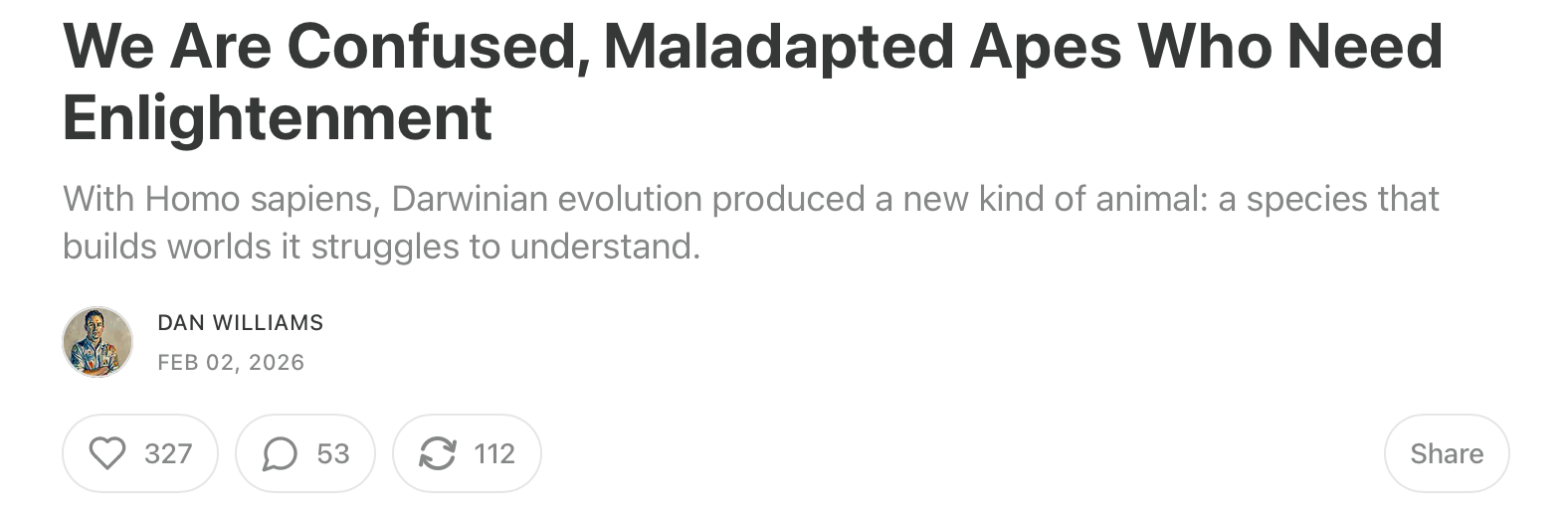
Williams’ piece was published on February 2, 2026, and as of this writing it has 327 likes, 53 comments, and 112 reposts, and some number of views that is likely very large but only known to Williams and Substack.
The first comment is by David Pinsof, which itself received 48 likes. That comment in turn formed the basis of a new guest post by Pinsof on Williams’ Substack, which received 128 likes, 45 comments, and 35 reposts, along with additional commentary by influential authors such as Arnold Kling.

The posts involved strenuous debate and disagreement concerning some fundamental issues, about which both authors cannot be simultaneously and ultimately correct. If one wins, the other loses.
Setting aside the question of who was right for a moment, however, the result of the disagreement was not that one author took influence from the other, but that the exchange produced more influence all around: more posts, more comments, more links, more followers, and more commentary and additional essays from other writers. Each now has a larger following than before the episode, a stronger set of claims on the feeds of other users, and therefore holds a greater set of standing commitments to be paid attention to by them -- and along with all that, a greater command over the collective attention space of the platform and the broader community itself. Their stature rose, as did the total amount of opportunities for attaining and exercising influence.
The General Formula for Clout
Through their exchange, Williams and Pinsof were able to carry out the social capitalist alchemy of transforming some initial endowment of influence, via posts, into more influence. This is a prime instance of what we can describe as the general formula for clout: I-P-I’. Yes, this is the social capitalist analog of the general formula for capital.
This outcome — more influence for all, even in the face of competition — is worthy of some reflection, since it helps us to think about the nature of one of the core topics in the Williams-Pinsof debate, namely, zero vs. positive sum thinking.
A central questions upon which the debate turns is the status of status. Pinsof (along with many others) seems to assume that status is inherently zero-sum.
status is zero-sum, and money is a status symbol, so it is arguably not a misunderstanding for people to view money as zero-sum.
In other words, status is inherently zero-sum, and since it infects other domains — for example, by making wealth and power into status symbols — it reveals those other domains as properly zero-sum contests for status, and therefore only seemingly divergent from our evolved tendency toward zero-sum thinking.
Pinsof is definitely right that status, understood as relative standing, has a zero-sum dimension. If I move from tenth to ninth, someone else has moved, or been moved, from ninth to tenth. It is a mistake, however, to infer from this that the broader domain of influence is therefore zero-sum by nature. “Zero-sum” is not a metaphysical property that attaches permanently to a human motive, like a curse in a fairy tale. It is, among other things, an institutional condition. Money can be hoarded, monopolized and used to buy political influence and social respect, but these pathologies do not show that markets were secretly zero-sum all along. They show that positive-sum capacities are institutional achievements, and fragile ones at that. My suggestion is that the same is true of influence.
Money and the capacity to act
My central claim is that platforms are institutions that make influence more money-like than it used to be. Whether a token of value operates more like a fixed tournament prize or more like money depends on the institutions that store, measure, transfer, denominate, and redeem it. Pinsof and Williams both seem to agree that money is or can be positive-sum (until or unless it is infected by status or rent-seeking), so it is worth starting by reflecting on what that positive-sum character means.
To understand this idea in more general terms, I find the observations of the great mid-century sociologist Talcott Parsons on “generalized symbolic media” to be helpful. In Parsons’ conception, money acquires its positive-sum character by expanding our capacities for action. It creates more degrees of freedom, along four dimensions:
Source. Holding money means that you are not bound to buy from one seller. You can shop around. This is a big contrast to, say, the situation of the feudal peasant. In a developed money economy, you have more options to purchase from more vendors.
Objects. Money increases your ability to choose what bundle of goods to buy from any given seller. This enables greater specialization.
Terms. You can bargain or shop over prices, by offering various terms. This communicates via prices to sellers what to make more or less of next time, and gives them an incentive, again via money prices, to achieve that goal.
Time. Holding money allows you to delay spending or spread spending over time, in longer durations and more fine-grained temporal units.
As these degrees of freedom expand, the total field of possible exchanges grows. A buyer has more options, sellers have wider markets: the division of labor grows. The monetary system — and money is an institution supported fundamentally by banks, the financial sector, government regulation and stability, cultural norms of trust, and more — enlarges the overall capacity.
To be sure, there are myriad ways this system can be undermined, such as rent-seeking, information asymmetries, externalities, monopolies, exploitative predation, and more. In fact, each expansion of the degree of freedom brings with it new bottlenecks to be exploited. If suppliers consolidate, the formal freedom to choose remains, but the real range of choice shrinks. You have money, but nowhere meaningfully different to spend it. The market may offer many items, but this can amount to 25 variations of the same breakfast cereal. Prices and terms can be formally open, but one side can have so much structural advantage the weaker party’s “choice” can only be written in scare quotes. And the freedom to wait can also undermine itself: money tends to lose purchasing power over time.
In other words, the very same conditions that expand degrees of freedom create new opportunities for alienation, exploitation, and disorientation. These all feed into what Perry Mehrling called “the inherent instability” of any money-credit system.
But even without invoking those, one can still arrange actors in a market order on a linear scale, where somebody always has more than somebody else, and intense competition is always producing winners and losers. Elon Musk has almost 2.5x more money than Larry Ellison — and even more than I do. Jeff Bezos is just a bit behind Ellison, and if Bezos can move up the list, this necessarily means that Ellison will move down. Money is zero-sum in that one person’s ascent is another’s decline, relatively speaking.
And yet, the median purchasing power of, well, humanity has grown massively all the same, not to mention that both Musk and Ellison are richer than they were ten years ago. For my part, even though I am way down the list, and my meager entrepreneurial efforts have not earned me great wealth, I have way more degrees of freedom than the feudal version of me would have: more and more various things I could buy, from more and more various different sellers, at any array of prices and terms, spread out over multiple time horizons.
The fact that some go up and others go down does not alter this fact, and in a well-functioning monetary regime, the competition to move up or down that scale also serves the function of discovering and revealing prices, opening up new and unknown types of products and services -- not only searching through an existing space, but whole new nodes in the division of labor. Growth and distribution are two faces of a market economy, and when things are working well, the latter feeds the former.

Influence and the Capacity to Act
There is much more to be said about this, but this is enough to draw attention to how remarkably similar the domain of influence has become to that of money. Thanks to the creation of institutions that permit influence to be accumulated, stored, transferred, counted and accounted for, withdrawn, created, destroyed – platforms – those same four types of degrees of freedom that the institutions of money and finance expanded in the economic domain have been expanded in the social domain.
Source. Having accounts on platforms means that you can receive posts from many creators, and indeed many platforms. This expands your options, and provides more opportunities for more creators to acquire influence.
Object. The capacity to allocate influence means you can choose what posts from which accounts to pay your attention to, assembling your own feed in the process. More producers in turn have more options toward which to target their efforts. The niche ecology becomes more differentiated..
Terms. You can offer more or less influence to other accounts, by way of various instruments such as viewing, subscribing, commenting, sharing, and the like. This enables competition for influence metrics to coordinate creator activity, similar to prices, and a mechanism by which producers can evaluate and modify their output.
Time. Platforms enable asynchronous influence. Posts can be saved or resurface later. Your follower counts, and the access to the feeds of others they entitle you to, persist beyond the immediate moment of attention. This allows creators and audiences to spread their activities and interactions out over longer periods and in more fine-grained temporal units. The effect is that influence earned by a post (from others granting it future access to their feeds) can accumulate well beyond the initial moment of posting, or indeed beyond the underlying “real” attention inspired by the platform, just like monetary wealth is far larger than the real goods and services produced at a given moment in a modern economy. For their part, audiences can continue to benefit from a post well into the future. Williams wrote his post months ago, after all.
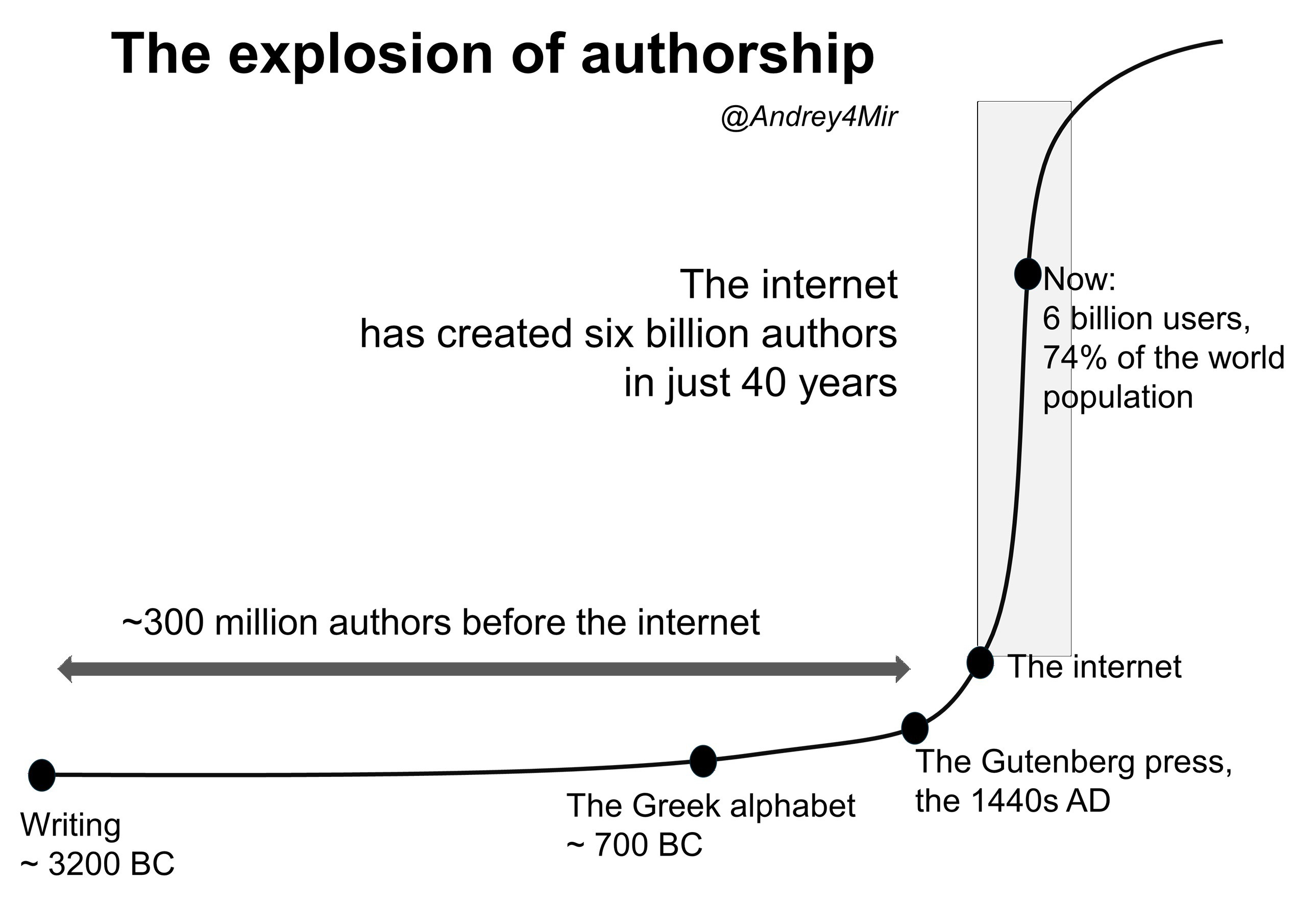
As these degrees of freedom grow, the total field of possible ways of being recognized and acknowledged by others grows. An audience has more options, more creators have more access to more and more diverse audiences, and niches multiply and connect. This graphic from Andrey Mir gives a sense of the scale of the transformation.
Tendencies in these directions exist in previous media forms. But platforms, through their core institutions of feeds, accounts, metrics, and, most importantly, mechanisms for transforming attention into bonds — claims (upon feeds) and obligations (to grant access to one’s feed) — mark a fundamental transition. Early images of “the attention economy” such as Michael Goldhaber’s, which envisioned “the net” on the model of a speaker enthralling a room, are fundamentally inadequate to what is better understand on the model of a bank administering a ledger. Influence binds, while attention is fleeting.
As in the case of money, more degrees of freedom bring with them their own reversals: more opportunities for exploitation, alienation, and disorientation, along all four dimensions. A few platforms or accounts can dominate access to influence. More content can mean more slop. The right to shape your feed through your actions can seem a rather pitiful form of freedom when somebody else has decided what is on the menu. And your accumulated influence decays: if you are not active enough, the same follower count loses value -- you can even lose your account -- and influence inflation can eat away regardless. 10,000 followers on Twitter in 2012 were worth a lot less than the same number a decade later. The result is discipline.
Frictions, moreover, eat away at your ability to use your influence. To adapt an idea of Fischer Black, at least as interpreted by Tyler Cowen: just as liquidity in monetary instruments is not a single number, neither is liquidity in influence instruments. It is not straightforward to get a following and reach from one platform respected on another, any more than it is straightforward to get a bar in rural China to accept my hard-earned Canadian banknotes. The numbers on your social media account do not automatically translate into an exact quantity of reach, any more than the numbers in financial accounts translate into an exact quantity of goods and services. This all feeds into the inherent instability of any influence-credit system.
Yet even as the system as a whole expands and degrees of freedom grow, one can still arrange actors in a platform order on a linear scale, where somebody always has more than somebody else, and intense competition is always producing winners and losers. There can be only one first reviewer of a new restaurant on Yelp. Elon Musk has over 2x more followers on X than Barack Obama; Williams has more Substack followers than Pinsof, who has more than me. If Pinsof or I can catch fire, we might pass Williams, and if Williams keeps on shooting down facile motivated theories of misinformation, who knows, maybe he’ll make up some ground on Musk!
And yet, the median power to make claims on attention and gain recognition has grown massively, despite there being some people with higher counts than others. Even though I am very very far down any list you might draw, I have way more degrees of freedom than I would otherwise have. Compared to the greatest prince ever to have lived prior to the 21st century, I have greater access to more essays on romanticism, rural American cities, Straussianism, looksmaxing, AI consciousness, and paeans to the value of attention; home repair videos, nature documentaries, philosophy lectures, investing advice; funny Catan memes, boxing tip reels, curling highlights, and much much more. Even if I lose, by playing the game, in all those other ways, I win — or at a rate, as long as enough people play the various games of the various platforms. And anyway, even now, my Substack essays earn a greater audience than most academic conference presentations do, not to mention readers of journal articles.
The fact that some go up and others go down does not alter this fact. In fact, the zero-sum competition to be first reviewer expands and refreshes the informational coverage of the platform. More generally, in a well-functioning influence regime, the competition to move up or down the scale also serves the function of discovering and revealing the social price of a post, while opening up new and unknown types of content and topics -- not only searching through an existing space, but whole new niches in the ecosystem. Growth and distribution are the two faces of social capitalism as much as they are of economic capitalism.
Collective and Distributional Power
None of this implies that the expansion of influence-capacity is the expansion of truth. A larger and more liquid market in takes may produce more Smiths, more Paines, more obscure geniuses rescued from institutional invisibility, not to mention more numerology, more partisan demonology, and more earnest critiques of the attention economy. Positive-sum is not a synonym for good. Yet recognizing the overlaps between economic and social capitalism can help to envision an approach to the ethics of the latter inspired by that of the former. Social capitalist platforms, like capitalist markets, are counter-intuitive moral contexts, in which second-best solutions are the best that creatures like us can expect.
Once this general point about the nature of symbolic media becomes clear, it is fairly straightforward to apply it to politics. I will not go far in that direction here, but it is worth noting the distinction mid-century authors such as Parsons, James Coleman, and then later Michael Mann drew between collective and distributional power. Collective power refers to the capacity of people to accomplish things together they could not do separately. It is the power to do, to mobilize societal commitments for collective goals, and it is enhanced through expanding infrastructural capacities such as financial systems, military organization and logistics, standardized measures, literacy, and the like. Distributional power means A’s power over B. This expands when one group increases its ability to impose its will on another.
Mann’s monumental Sources of Social Power documents and seeks to explain the truly remarkable expansion of collective power over the last 10,000 years or so of human history. Much of it covers innovations such as Roman military logistics, which enabled a Roman leaders to make decisions that reverberated far and wide, or the Swiss pike spear, which enabled tight bands of soldiers in phalanxes, bound together through deep bonds of mutual trust and solidarity, to undermine the military basis of feudal aristocratic power — not to mention ideological transformations, such as the spread of democratic ideas, which contributed to mass mobilization of citizen armies.
American history — and Mann is no cheerleader — by and large shows a similar expansionary arc. The U.S. President has been able to mobilize and bind actions over a larger swathe of the globe than any actor in previous history. This situation led Mann to describe the global power structure that predominated around the end of his fourth volume (circa 2013) as defined by the trifecta of capitalism, the nation-state, and America.
A party system becomes positive-sum, when it is, because the rules of the contest force private ambition and factional struggle to pass through institutions that build collective capacity. It is not positive-sum because parties are secretly nice, altruistic, unconcerned with their own standing. When it is working well, it pushes parties toward policy innovation, keeps them in touch with the citizenry, while forcing rival social interests to organize themselves, articulate general programs, mobilize mass publics, and build state infrastructures capable of redeeming their promises.
Distributional power does not disappear, far from it, and in fact, the stakes become higher. For example, the same infrastructure that makes pensions and tax collection possible also makes mass surveillance possible. Competitive democracy can produce a state that is less despotic but more penetrating. It expands what “we” can do, but it also intensifies the struggle over who gets to speak for the “we.”
Expansions of collective power are fragile, because the infrastructure they generate cannot only be commandeered by but undermined through distributional contestation running amuck. Such self-undermining races to the bottom are regular occurrences in complex systems, not unlike the peacock male evolving tails so large that they can barely walk. A US party that, in its effort to defeat its opponent, undermines the infrastructural power embodied in the US dollar being the world’s reserve currency is a case in point — for now, I’d still have a much higher chance of getting a beer in rural China with my US dollars, but will that last? Either way, this is not an instance of modern actors seeing through the veil to the truth of our situation, that all of this has been really zero-sum all along. Rather, it is a major challenge to an institutional design for transforming distributional contestation into collective capacity.
A sociological understanding of symbolic media
I’ll conclude by returning to the broader point. The creation of infrastructures and institutions that can store, measure, create, destroy, transfer, and price influence — platforms — is a truly transformative event, and we are still only beginning to understand what platforms really are and what they mean, even if it is beginning to seem passé to discuss them as we all rush ahead to speculate about what AI will bring. The Owl of Minerva is starting to fly, and it is time to revisit basic questions and assumptions about what a platform even is.
Just as important is that there were a host of very powerful intellectual tools developed for understanding such questions about the nature of symbolic media and their institutional conditions back in the heyday of mid-century sociology, which are worth the while of scholars and intellectuals today. It is understandable that those ideas have faded from the Discourse: sociology has largely neglected them itself, to its own detriment, coming to define itself more or less exclusively by the study of distributional questions. Nevertheless, there is much there to be learned, not least about when and why such a focus can shift from salutary to self-defeating.
I need to catch up with a bunch of your posts and this latest looks pretty ambitious (tour de force? You tell me). So it will be awhile. But one very quick thought: along with the symbolic influencers, at some point it may be worth thinking about the perspective of much smaller fish - reply guys and lurkers and occasional commenters like myself - who have near-zero chance of real influence and usually couldn't care less. For many people on these platforms it's simply about a desire for a little more social connection, or intellectual hunger, a way of keeping mentally engaged, a personal interest in the writer's evolving thought, or even just a comforting ritual. I think this is a key part of any "influence economy" on the demand side (maybe also supply-side in a certain sense), if orthogonal to the kind of symbolic capital you appear to be stressing here.
But this may well be irrelevant to what you're after - not at all confident about any of this (and perhaps comments like mine could be reconstrued as a bid for influence). Just something that struck me while I was skimming.
Great post