
Social Media Platforms are Staged Clout Competitions
Why we fight


Across the various actually existing platforms, there are a number of different rule sets. This is not dissimilar from that fact that across different sports leagues, there are different rule sets. Both platforms and sports leagues are staged competitions that determine what counts as winning and which strategies are allowed in the pursuit of the rewards they offer. Highlighting that these are all staged is important, because the word “competition” is sometimes associated with a quasi-Darwinian idea that cut-throat competition is just natural, which in turn justifies organizing an economic order on that cold-hearted “rugged individualism” instead of the warm embrace of collectivism.
Staged competitions like those hosted by sports leagues and platforms are obviously not natural at all. I think of this every time I hear a professional athlete discuss all the adversity the team had to overcome on the way to their championship. That adversity usually comes from the logic of the game: there are other competitors trying to win too and get in your way! If, say, in basketball everybody would just cooperate to let the other team score whenever they want, we could immediately put an end to all that adversity.
But that would undermine the point of the league. This means that some players with great natural athletic gifts but who lack a very strong competitive drive often fail (Ben Simmons, I am looking at you). This is unfortunate but sports fans and leagues accept it because of the much larger benefits that the competitive structure generates, in which the non-competitive but gifted athlete also can share to some degree (not only did Ben Simmons make a lot of money, he also gets to watch the games). The same logic is what justifies staging clout competitions.
Lurkers as Shirkers
It is worth reflecting on why so many different platforms with so many different rule sets would converge on the competitive clout tournament. Part of the answer comes from what every teacher has experienced in assigning some group project to the class. It always sounds like a good idea: students will work together, share knowledge, allocate tasks, and learn from each other while producing better work than they would do individually. Three cheers for the benefits of cooperation!
But we all know it almost never happens that way. Usually one or two members of the group do all the work. Sometimes the grade is enough to motivate those few to do the work of the many, but seeing your groupmates be rewarded for low effort is demoralizing. This in turn leads even the best students to underperform. Seeing your classmates succeed by pushing a button and generating an AI essay has the same effect, and if this goes far enough, students pre-emptively scale back their efforts. Why even try if the game is rigged?
Shirking, or offensive free-riding, leads to defensive free-riding, which leads to pre-emptive free-riding. In a small classroom setting, it is sometime possible to solve this problem through direct monitoring and mutual control. Teacher is watching!
If you participated in early social media and other internet forums, you’ll remember how they often ran into similar problems, as do WhatsApp or Discord groups today. The forum works best when everyone participates, and since it often starts from a small group of friends or committed enthusiasts, this works well for a time. But inevitably, a few people take on more of the burden of maintaining the community: writing more posts, moderating them, commenting, and the like. This often breeds some resentment toward the rest, who lurk, which is to say, shirk. In many cases, this leads the few initially active members to reduce their activity, and some unknown amount of others to never start. The vast majority of Discord servers have almost no active participants and very little activity.
One type of solution to this problem is a kind of fractional incentive. Those who take on the greatest burdens gain some share of the social benefits they generate for themselves. In a forum, this could amount to some exclusive rewards for those who post a certain number of times a week, for example. Moderators might earn a badge, or top commentors might get some applause or periodically get to take over the account. These solutions retain the socialist cooperative logic of “to each according to their contribution,” even if they tilt some extra recognition toward those who put in the most effort.
Competition for prizes changes things more fundamentally, however. Teachers see this when for example students have opportunities not just for grades in their class but to enter and perhaps win a national or international competition. Students from all over the country (or world) all have a personal incentive to study as hard as possible, outdo the others, and win the prize. Since the reward does not go to everyone, it can become very large, so much so that it can loom larger than the local reward, even if almost nobody will win. Moreover, if everybody feels they have a reasonable chance to obtain it, participation tends to increase and compliance becomes easier — those kids competing for the prize become very very sensitive to every little change in the rules and reward structure. This is, by the way, the same logic survey researchers often use when they offer participants a chance to win an iPhone in a lottery rather than a tiny guaranteed payment for participation.
It is also what motivates the creation of much and much more content to be shared with others. My son is in eleventh grade, and one of his friends and classmates is already a popular TikTok and Instagram creator, with large followings there and several viral hits. She is also the class president, she won the school science fair, and, on top of all that, is a straight A student. In other words, she is no slacker, and becoming an influencer is part and parcel of the same competitive drive that leads her to outdo her peers in other arenas.
Similarly, my daughter, a first year university student, often tells me about people at her school who become local influencers there, mostly through producing very helpful and fun videos that show new students about tips and tricks for campus life. When I ask both of them why people spend so much time and effort doing this, they always say the same thing: they want to go viral (followed by rolled eyes and “duh dad…).
That very very large prize offers an incentive that keeps them working, along with the many others who think they have a legitimate shot at it . You see the effect of this on influencer forums (as well as in ethnographies of creators), where contributors discuss the influencer life as a constant grind. It is what lies behinds the close analogy between the ethos of the influencer and that described by Max Weber in the Protestant Ethic and the Spirit of Capitalism.
First!
The major transformation introduced by a competitive structure is to make rewards relative. You win if you outdo the other. This is why, from the point of view of the competitors, the competition can be seen as a race to the bottom. Just like adversity could be removed from the NBA if everybody stopped playing defense, all those influencers could stop complaining on Reddit forums about working so hard and rarely going viral if they all just agreed to scale back their production. However, since only few will win the prize, and there is always somebody who might outdo the ones who do shirk, the race continues. The question is if it produces enough value for the rest of us to justify it.
My PhD student Khalil Martin came up with a clever way to observe how platform’s build this kind of competitive dynamic into their architecture, and study its effects on the type of posts they generate. Specifically, he studies the competition to be the first to review an amenity on Yelp, and then compares the geographic scope of coverage supplied by those “scouts” to non-scouts.
Here is how Khalil JRM puts it (in a draft of a terrific paper in progress):
On the Yelp platform, users are awarded a point for being the first to review a listed amenity. The tally of each user’s firsts points is displayed on their profile, along with other metrics like the number of votes their reviews have garnered, the number of followers they have, and more. The firsts metric is one score around which users can enter playful competition with themselves or with others, where the higher the score the better.
Specifically, through the firsts (hereafter ‘first-review’) metric, the platform may further encourage users to seek out, and try, amenities that are lessor known. Although the informational nature of platform participation inherently promotes some such scouting behaviour , the idea is that the first-review metric makes the reward for scouting behavior more acute and accountable. It is beneficial to the Yelp operators, as well as to everyday information seekers, that some segment of users actively seeks out, and reviews, new amenities.
This ensures that informational coverage of the platform is constantly extended or refreshed in a timely manner. However, note that each time an amenity is listed to the platform, there is an opportunity for only one user to be accredited a first-review point. This zero-sum situation which different users may respond to in different ways. Some may choose to actively pursue first-reviews, while others may choose to focus on other metrics. The former effectively serve as the ‘scouts.’
Khalil develops some cool methods to identify these scouts, who make up about 300/4200 users (with at least 30 reviews) in a detailed dataset of Yelp reviewers in Philadelphia. Strikingly, the scouts have an average first-review share of 10.3% versus 2.2% for the total collection of users.
These hyper-competitive reviewers cover a lot more territory than their less competitive counterparts. Khalil matches a scout with a similar non-scout (a user with no first reviews, but similar total reviews) and then tracks their geographic footprints. Here is an example of a matched pair:

This example is of a very general process:
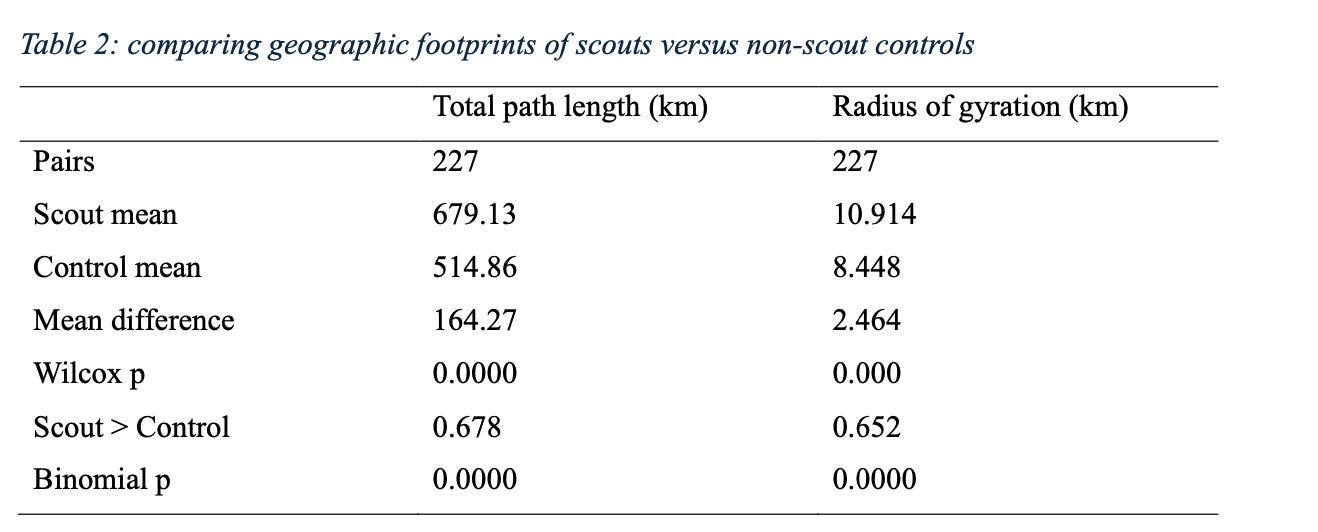
This is one part of a great study Khalil is doing, which is one part of what promises to be a great dissertation. For present purposes, the key point is that platforms like Yelp do indeed stage clout tournaments, which elicit a great deal of activity from its participants, from which the rest of us benefit, in the from of more reviews of more amenities covering more territory, much like we benefit from greater athletic achievement through competition for victory in the Olympics or from greater mathematical achievement through competition for victory in the International Mathematical Olympiad.
To the extent that something like this outcome tends to occur on the basis of the clout competition’s rule set, then it is realizing its point. The justification of sending Yelpers on a race to the bottom is that on their way down they generate more and more varied content than anyone would have thought possible. The social bounty grows on the back of a small minority’s effort, while most of us, like the bad students in the group project, simply lurk and consume. For their trouble, we get more of the types of content already there (jokes, home repair advice, exercise tips, political debate, and so on). And the tournament also pushes the players to seek out new formats, genres, weird niches, subcultures, and even new platform rule sets, expanding the possibility space further. This is the sociological equivalent of the Hayekian economic discovery process through competition.
Competitors Conform
To be sure, there are a number of ways in which platform staged clout tournaments can become exploitative and produce their own new costs and externalities. The heavy production burden falls on the competitors, not the lurkers. If participants themselves do not get to share any of the rewards the platforms generate, that would definitely be gratuitous. If they are permitted to sabotage one another’s efforts, this would undermine the entire practice. Similarly, if every post is greeted by aggressive or bad-faith comments, fewer will participate, and if users find the typical experience offensive, they will eventually log off or move elsewhere.
Exactly when this happens is a matter for the internal ethics within the clout tournament, once it gets going. That is a different question from the one we are asking here, which is about the justification of the tournament as such. That justification is relative not absolute. It must remedy compliance problems that cooperative solutions cannot, and it must deliver at least as much, but ideally more, than the non-competitive solution would. If, for example, a reviewer cooperative would generate more and better reviews than Yelp’s staged competition for the “first” honour, then the competition would begin to look gratuitous.
Put differently, the rules of the tournament must serve the point of the platform. This means that if those rules systematically undermine the platform ecology, they fail the normative test that justifies their existence. I am not alone for example in rarely posting on Twitter/X for fear of the environment there on the public feed, and not just for that: the systematic downweighing of posts with links to my essays here leaves me seeing little reward there. Even so, this same situation is part of what sparked the growth of Substack in general, and which in particular pulled me out of my dogmatic slumber as a long-time social media lurker. This in turns brings my posts, for what they are worth, to the feeds of at least a few others who would not have encountered them.
The ethical point is that platforms, like markets and professional sports leagues, though they are highly competitive, are not morality free zones. They all operate within institutional rules that constrain what competitive strategies you can choose.
In fact, because platforms involve a moral compromise that permits competitive and instrumental attitudes towards others, participants’ behaviour becomes more tractable to institutional design. Competitive clout chasers respond to platform rules, as do grade grubbing students. As sociologist Ashley Mears reports in her ethnography of a Vegas hype house specializing in viral Facebook videos, when Facebook changed the types of posts it rewarded, they simply researched the effects of the algorithm changes, and then adapted to the new situation.
Meta announced a change that had widereaching implications for Lax and his creators. The company was going to stop promoting what it called “watchbait” - videos that “create an arbitrary curiosity gap” or promise sensational revelations. Both Lax and Dein saw their audience and earnings fall abruptly.
This didn’t deter Lax. He and his creators have been posting videos of different lengths on their pages to “clean” them up for the watchbait filters and making it clearer that their work is scripted. Facebook seems keen to promote feel-good videos these days, so they’ve been doing fewer pranks and more crafts and cooking (with a surreal twist, naturally: pianos painted with garden rakes; dyeing children’s shoes with Skittles). The network is now climbing back to the same viewing levels it was achieving before.
Similarly, when Instagram changes its rules for rewarding sharing others’ posts such that barely modified posts would not be rewarded (or the rewards will flow to the original creators), this changes the incentive structure under which aggregators or curators operate, and they usually respond.
All of this can occur even if the creators and curators themselves do not care at all about the overall good or point of the platform. Mears’ subjects do not care about “feel good” videos, or whatever else the platform’s various influence metrics are rewarding. The intentions of the clout competitors are not very central to the question of their ethical status. The key is that their actions are consistent with the point of the tournament, whatever their intentions.
The trick of course is to align these incentives with the public benefit the tournament promises, and often they do not. This problem is not unique to platforms. The same issue arises in sports leagues. For example, Major League Baseball suffered for decades under rule sets that produced dull and uninspired play, driving many former fans away from the sport.
This definitely happened to me: for most of my life, opening day was the best day of the year. I had encyclopedic knowledge of every San Francisco Giants team ever, and would live and die with those guys. I would even defend Barry Bonds! I was that guy cheering him on in the left field bleachers in Wrigley Field, as everybody else threw needles at him. Orange and black, baby, orange and black.
But as the game bogged down, I completely lost any passion for it. I remember when this hit its nadir, when one day I turned on a Giants game and just felt…nothing, nothing at all. What a strange feeling, to look at something you loved, and to see instead grown children in funny outfits running after a ball! This is what happens when a competition fails to realize its point.
Yet the thing about a staged competition not being natural is that there is always a chance to rebuild it. In the case of baseball, new rules sped up play and produced innovations. Last year, fans were treated to one of the most exciting World Series in decades, in which tens of millions of Americans watched a scrappy Canadian squad nearly defeat the best “team” money can buy.
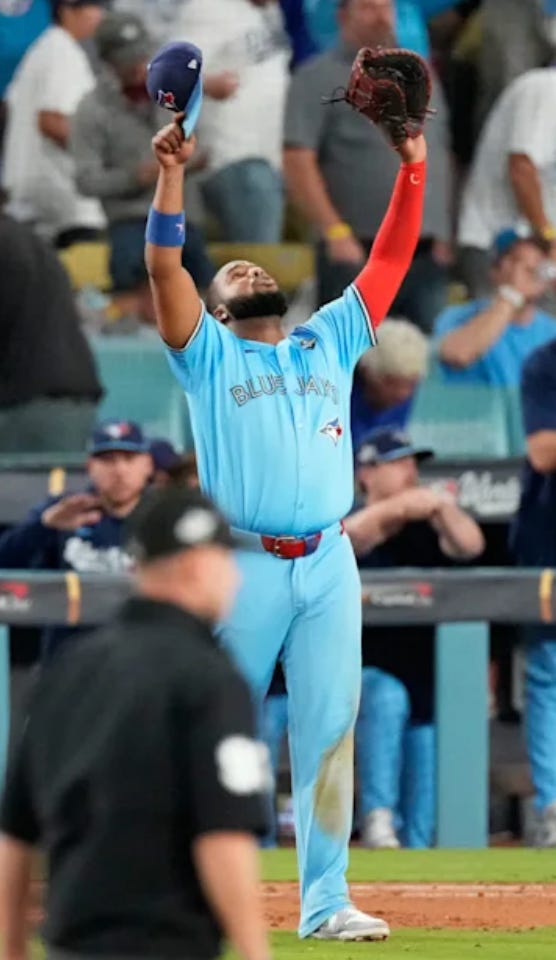
Even if the most deserving squad did not win, the rules succeeded in realizing the point of the league. Consider another example: Early UFC was so unregulated and violent that many worthy competitors would not participate, and many fans would not watch. The introduction of some basic rules led to a flourishing of the sport and what has probably been the most rapid and intense exploration of the possibility space of martial arts ever, kicking off a period in which it feels like we are operating according to something like Moore’s Law of Martial Arts.
The internal ethics of social capitalism on platforms is closer to an MLB or NBA rules committee working on the game than to a drama about the purity or corruption of our personal or collective souls. The rule sets that work best arise from trial and error and are themselves important social discoveries. The broader platform ecosystem can be viewed as an ongoing competitive discovery procedure around the implications of one way or the other of structuring influence instruments. For example, the integration of “stories” and distribution restrictions into Instagram feeds is one way to preserve a more close-knit form of interaction alongside the more competitive open arena of Reels. To the extent that some strategies that work better than others emerge through this process, this expands the collective capacity to share ideas and recognize one another.
Giving the moralists their due
Still, we cannot and should not dismiss the concerns of the moralist. It is not difficult to see why, no matter the scope of the benefits, discomfort with achieving them through clout competition for influence persists. We tend to think of altruism or care for others as a good thing, but this is not usually the best strategy for outdoing them if they are your competitor for top spot in your niche. We also tend to think about our friends and relationships and hobbies as existing for each other and themselves, not as fodder for increasing our influence. Thus the justification of the clout tournament involves a capitulation to some of the less flattering features of the human condition.
Moreover, the justification rests on its superiority over an alternative that is often hard to envision. The clout tournament’s value assumes that human beings are simply too self-serving and self-interested for the more cooperative mode that works in the closely monitored classroom or tight-knit forum. Maybe so, the moralist might say, but this just means that people should be better. In fact, one can go further, and suggest that because platforms do not just indulge but actively promote the competitive instrumentalization of social life, if platforms were to disappear, much of that competitive instrumentalization would disappear with them.
This intuition lies behind the proposition that social medial platforms on net and in morally indefensible ways increase invidious comparison and the hollowing out of human relationship through an ever expanding self-fulling prophecy. It does not help matters that the ones who benefit most from staging this competition — the platforms, the top accounts — have great incentive to exaggerate how bad things would be if platforms would cease to exist. The upshot of all of this is that any specific claim about how to organize a clout tournament is a matter of judgment that constitutes a major challenge of institutional design and management.
Given the coordination and discovery problems just described, it is natural to ask whether we could get the same benefits without organizing production through a tournament. There are in fact many arenas of content production where the process is carried out through a plan and in a not straightforwardly instrumental way. For example, inside a magazine or newspaper, content producers are often assigned topics to write about, and experiments in letting “traffic” fully determine these assignments have not always proven effective, to say the least.
Moreover, the promise of Big Data, Machine Learning, and now AI has seemed to some to be that they would overcome the need for a tournament to find out what people should produce. We can observe people’s tastes and desires at such a fine-grained level that we can predict and produce what they want before they know it. This would in turn create the possibility of setting a production schedule that would perfectly match the supply of social content to the demand, with no need for the competition for influence to indirectly achieve that outcome.
Readers familiar with the history of political economy will recognize that the twin problems of calculation and incentive loom. The problem of determining what tasks to perform and where to assign them is the calculation problem; the problem of overseeing any plan at scale and keeping people from gaming it is the incentive problem. These problems still pose considerable challenges even in the era AI, and understanding the limits on planning that they generate helps to understand the point of the competition, and why all existing platforms continue to introduce it.
Taking these problems seriously is the topic of my next post.
The suffering of Nets fans with Ben Simmons was likely the worst because he was too hurt to get any of the value out of his monster contract.