
Neil McLaughlin on C. Wright Mills and Sociology’s Nightmare
Alvin Gouldner and the Crisis of Contemporary Sociology

DS: Today’s post is a guest essay by neil mclaughlin. Neil teaches sociological theory at McMaster University, and writes on the sociology of intellectuals. He wrote to me with some very interesting reflections in response to my essay on C. Wright Mills and The Sociological Over-Imagination. I suggested that he expand them into a guest post, and to my delight, he agreed. The post brings Alvin Gouldner into the conversation, arguing that his concept of “theoretical nightmares” can be applied to the situation of contemporary sociology.
Daniel Silver’s reflections on the 1950s and 1960s era debate between C. Wright Mills and Talcott Parsons are a useful reminder that sociology’s founding disputes are more complicated than the simplified stories we tell our students. In our textbooks and introductory courses, Mills typically appears as the hero of public sociology: the defender of the sociological imagination, the critic of power elites, and the scholar willing to speak plainly and with substance to a wider audience on social problems that affect individual lives.
Mills got much right, so his revered status in sociology is justified. Mills’ example helped establish the ideal of the public sociologist long before that term became fashionable. For many sociologists, Mills remains proof that serious scholarship can also be publicly engaged even if some are rightly concerned than Mills and the Michael Burawoy tradition that he inspired is too dogmatically left-critical. Mills work on power elites remains relevant in an age characterized by concentrated corporate power, technological monopolies, widening economic inequality and a global oligarchy in the wings.
It is reasonable, of course, to point to different perspectives on sources of inequality in contemporary society that complicate Mills pessimistic account of the power elite and the lives of the working and middles classes. It is hard to deny, however, that his contributions shape our scholarship and the education of our undergraduate and graduate students, even if few read his books today. Above all else, Mills’ sociological imagination brings students into the discipline by helping them see how their own personal biographical problems are about history and social structure and can be addressed by social change led by social science.
Parsons, by contrast, is remembered as the architect of abstract systems theory whose dense prose symbolized everything wrong with a postwar sociology that was essentially a conservative justification for the status quo. Silver’s work on the reception of Parsons and Mills, both in published academic works and this Substack, suggests that this familiar story is too simple. While Mills was often insightful, courageous, and intellectually innovative he was also a polemicist with an axe to grind. Mills’ attacks on Parsons frequently relied on ridicule rather than careful engagement with theoretical content. Mills’s mockery of “grand theory” create a caricature that still shapes and distorts the discipline’s collective memory.
Something similar can be said about Mill’s treatment of Paul Lazarsfeld and survey research, as he famously dismissed the mainstream quantitative tradition that came to dominate sociological research beginning in the 1950s as “abstracted empiricism.” Mills lost that battle, and sociology programs now center quantitative training and research even if Mills’ critique offers an alternative view that legitimizes some of the resistance to modern multivariate analysis that we still see in our discipline. At his best, Mills work was a reminder of the importance of preserving the craft of sociology in the wake of pressures towards the field becoming fully dominated by technicians. At his worst, however, Mills legitimates anti-intellectual dogma and ideology.
Mills often won arguments rhetorically in ways that create heroes, villains and myths, something key to understanding his continued appeal. This does not lead to a politically balanced and empirically careful sociological imagination, a problem we can rethink with the kind of empirical research on the reception of sociological theory Silver and his collaborators engage in.
I would like to sharpen this analysis of the negative consequences of the reception of Mills in sociology, using the insights of Alvin Gouldner, a powerful 1960s era sociologist who was part of the broader New Left intellectual movement that allowed Mills and his generation to de-thrown Parsons. Alvin W. Gouldner (1920–1980) was one of the most influential and controversial American sociologists of the postwar era. Trained at Columbia University and later a professor at Washington University in St. Louis, Gouldner established his reputation through empirical studies of organizations and bureaucracy, particularly Patterns of Industrial Bureaucracy (1954).
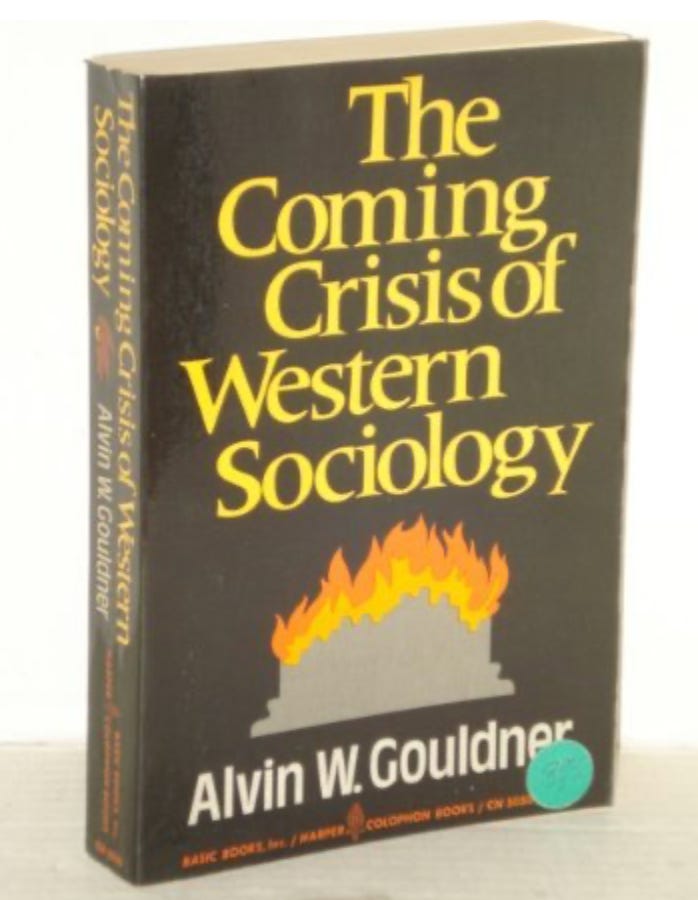
During the 1960s and 1970s, however, Gouldner became a leading critic of mainstream sociology, particularly in his The Coming Crisis of Western Sociology (1970). Goulnder, like Mills, argued that the discipline had become overly technocratic, politically complacent, and detached from the major moral and political conflicts of modern society. Mills was dead, of course, by 1962, and Gouldner had no interest in being a public sociology or a textbook writer, so he not Mills developed the most sophisticated scholarly critique throughout the 1970s of Parsons, Goffman and Merton, and other leaders of the post-war sociological field in the period. Gouldner inspired a generation, the graduate students of the New Left generation who entered the field and professionalized in the late 1970s and 1980s, free of the Parsonian and Mertonian dominance that Mills and Gouldner were shaped by and rebelled against.
In The Coming Crisis of Western Sociology, Gouldner argued that postwar sociology—especially the structural functionalism associated with Talcott Parsons—was entering a profound intellectual crisis. Gouldner maintained that sociologists could no longer pretend to be neutral observers standing outside history. Instead, every theory reflected the social position, values, and commitments of those who produced it. Gouldner called for a more “reflexive sociology,” in which scholars critically examined their own assumptions, institutional interests, and political commitments rather than claiming complete scientific objectivity.
Like Mills, Gouldner was not a perfect role model for contemporary professionalism. Gouldner’s critiques of Parsons, value-free sociology, and liberal academic complacency were powerful, but they were delivered with a prosecutorial certainty that appeared arrogant to many colleagues. The notorious 1968 Laud Humphreys incident, in which Gouldner was accused of physically attacking a graduate student over a satirical poster, established a reputation for volatility.
Gouldner’s fate is therefore ironic: the great theorist of reflexive sociology and the “flawed universal class” of the new class was himself often seen as a flawed intellectual, brilliant at exposing the self-deceptions of others but less successful at softening his own. But unlike Mills, Gouldner was willing, at least in principle, to turn his reflexivity on radical intellectuals themselves in ways Mills never did, especially in Two Marxisms: Contradictions and Anomalies in the Development of Theory. Gouldner’s book and his broader reflexive sociology predated Bourdieu theories and provides a framework for thinking critically about Mill’s concept of the sociological imagination discussed in Daniel Silver’s recent Substack post.
Silver’s account of core argument of “The Promise” argues that the continuing relevance of Mills is rooted in the popularity of the case he makes that “sociology can be a beacon of clarity in an increasingly confusing world.” Silver writes:
Mills begins with his famous observation-cum-injunction: that people today often feel trapped by their private lives, unable to grasp the larger historical forces that shape their experiences. The core of his “promise” is the Sociological Imagination: a quality of mind that enables us to grasp the connection between our private troubles (one person’s unemployment, a couple’s marital strife) and broader public issues (a nation’s high unemployment rate, legal restrictions on divorce). The Sociological Imagination is the ability to link our individual biography to the grander sweep of history and social structure.
Our students love Mills and the sociological imagination because all individual problems can be explained through this social lens which was right about many issues. Who would not want to major in a field that helps one understand, and potentially resolve, all one’s personal troubles? This sets our students and our discipline itself, however, for an obvious rebuttal: is it really the case that one’s inability to succeed in the labour and marriage markets are fully social problems, with no connection to bad individual decisions, negative character traits, dishonesty or delusions? To ask that question is to answer it, but this is not the kind of discussion that is encouraged in introduction to sociology classes, or graduate seminars.
Gouldner’s concept of “theoretical nightmares” helps us see how both the genius and the limitations of Mill’s sociological imagination and his theoretical frame prevents sociology from dealing with this obvious contradiction. For Gouldner, all theoretical systems have an emotional and symbolic life of their own, including a need to defend the boundaries of what is acceptable discourse within a school of thought by expelling ideas that pose a challenge to the theoretical system itself. Ideas that challenge an intellectual system can never be fully expelled from discussion, however, and the most serious challenges tend to emerge within the theoretical system as an unconscious “nightmare” that keeps theorists up at night and on guard in the interests of protecting the purity and consistency of their system. The repressed nightmares never go away, however, because the problem is with the theoretical system itself.
Gouldner developed this argument most fully in his sociology of Marxism. Marxism’s nightmare was the possibility that the working class might not become the revolutionary force and universal class predicted by Marxist theory. What if workers preferred reform to revolution? What if they became attached to nationalism, religion, consumerism, or liberal democracy? What if the abolition of private property failed to solve the deepest problems of social life? Such possibilities haunted Marxism because they threatened the coherence of the entire theoretical system. Marxists have a complex set of strategies they use to avoid these questions, as they either expel heretics or develop explanations and theoretical traditions that protect their foundational commitments in the form of Neo-Marxisms that focus on culture, gender, race or other ways to preserve the theoretical system in modified form.
Goulder’s insight, however, extends far beyond Marxism - Freudian psychoanalysis provides another example. Freud developed a powerful account of human suffering rooted in unconscious conflict. Yet psychoanalysis has always downplayed the possibility that some forms of suffering may not be psychodynamic in origin. Biological illness, neurological conditions, genetic predispositions, and simple misfortune do not always yield to psychoanalytic interpretation. Nor can psychoanalysts really deal with the broader forms of structured inequality that Marxists and sociologists do a far more credible job of analysing.
In my own work on psychoanalysis, I have argued that psychoanalysis, like Marxism, has its nightmares—questions that threaten the coherence of the tradition itself. Maybe it is not possible to fully heal patient’s emotional lives in clinical settings without a broader change in society, more equality in families and communities, less craziness in politics and social media? Contemporary psychoanalysis is currently being torn apart by internal debates about racism within their organizations, conflicts over medical care and therapeutic treatment for transgender youths and even the Israeli Palestinian conflict.
Perhaps the psychoanalytic focus on understanding the Oedipal complex, internal psychic conflicts and early family emotional dynamics just does not take the field very far, given all the problems in the world and in people’s lives clinicians of good faith have been asking? When psychoanalysts try to deal with the bigger questions of politics and social structure, however, they don’t do a good job addressing them because they are not equipped with the analytic tools or organizational resources. They end up damaging their ability to do therapy and healing, as their institutes descend into political battles and acrimony. Dealing with psychoanalysis’s nightmare in a mature way, would involve updating their theories and accepting the limits of their craft. Instead, the field engages in civil war over something that cannot be fixed but can only be accepted and adjusted to.
Sociology has a similar problem, that cannot be understood and addressed without serious attention to C. Wright Mills because sociology’s core nightmare is that some personal troubles may not be fully social problems. If one remembers the old joke “How many sociologists does it take to screw in a light bulb?” the answer “None, since it is not the light bulb that needs changing but society and its social structure”—nicely identifies sociology’s core repressed nightmare. For sociologists it is a profound challenge to our way of thinking and our research traditions to suggest that individual people (or light bulbs, if you accept the analogy) require changes at the social psychological, cultural, and depth psychological levels in order to see the emergence of a decent, fair, or just a sustainable society. From the sociological perspective, it is all about the structures, and that is clearly not true.
In the current political moment, furthermore, and in the context of the ongoing institutional crises universities are facing, particularly in the United States, C. Wright Mill’s promise, for all his insights, is getting in the way of changes we need to make to revitalize our field. A mature sociology should be able to acknowledge that some troubles are indeed public issues while others may arise from biology, chance, character, family dynamics, culture, or individual choice. Human problems involve multiple causes; sociology contributes one set of explanations among several. There is a major imbalance in the political views of professors throughout all disciplines in contemporary universities that has many causes, as the work of Neil Gross has shown. Sociology’s one-sided focus on the social roots of all personal problems, however, surely helps explain why we have so few conservative, religious or even politically moderate practitioners of the sociological craft.
Parsons, in contrast, reminds us that society is far more complex than the model Mills offered us. Parson’s work emphasizes systems, institutions, differentiation, adaptation, and multiple forms of causation. Mills offers something more immediately attractive and gives sociology a moral mission. Mills provides a language for linking private suffering to public injustice. Parsons reassures sociologists that their discipline occupies an essential place in the intellectual landscape, but encourages us to dialogue with psychologists, economists, biologists and anthropologists, an essential move in a moment where simplistic tropes about all social problems being caused by social inequality and structures are just not credible.
If Mills helped sociology find its public voice, Gouldner can help sociology find something equally important: intellectual self-awareness. In an era when sociologists are increasingly called upon to explain political polarization, mental health crises, and drug crisis that self-awareness may be more necessary than ever. Not all these issues, and the personal troubles they create are explainable in purely sociological and structural terms as the Mills framework insists.
If we try to explain Trump’s two presidential victories as coming from the fact that Republican voters do not fully understand the social causes of inequality, crime, homeless and drug addiction in the sociological ways we do, we are avoiding some hard questions. If we see the mental illness crisis as a social problem only sociologists can solve, we are deluding ourselves. Surely political conservatives, religious leaders and experts in the neurosciences have something to say about these issues. Is the massive drug crisis among young man in North America, with fentanyl overdoes laying waste to so many youth lives simply a social problem requiring a change in social structures? Or do we need to address the effects on addictive drugs on young bodies, economic incentive structures and the ways that bad decisions over time leave some members of our societies left out of the social contract. Policy makers and the public today have less confidence and trust in the sociological perspective than they have had in decades, and part of this is due to the destructive rhetoric of irresponsible anti-intellectual populists of the right. But surely part of the problem is the sociological imagination does not offer anywhere near the level of insights into these multiple contemporary social problems as some of us have convinced ourselves they do.
Perhaps the most valuable lesson we can take from thinking about Mills through Gouldner, is that sociology flourishes not when it avoids its nightmares, but when it confronts them directly. Mills encouraged us to look beyond the individual toward society while Gouldner encourages us to look back at sociology itself. If Mills remains the patron saint of the sociological imagination, Gouldner may still be the discipline’s most underappreciated guide to intellectual humility even though no-one ever accused him of being a model of humility himself.
Sociology needs to also find more appreciation for living with contradictions, ironies and insights that can be found in places we might never first look first. That means drawing on Gouldner to address the obvious flaws in our own theories, and engaging with more conservative, moderate and religious thinkers and scholars even though he was part of the problem of an overly ideological sociology in the 1960s and 1970s. To do all this, we must drop the strawman account of functionalist sociology that Mills’s promise helped institutionalize at the core of our contemporary discipline.