
On Grand Theory
How an epithet became a category which became a memory


This post introduces and summarizes our new paper, “Grand Theory in the Sociological Canon,” which recently appeared in the European Journal of Social Theory.
Here is the abstract:
Since the 1960s, “grand theory” has increasingly been used to categorize and discuss sociological theories. The result of this is, ironically, a discourse in which it is neither clear which theories count as “grand” nor what such a characterization indicates. By rooting our analysis in a corpus of 3,673 chapters of English-language textbooks, we offer an empirically-grounded contribution to the debate on the past and future of“grand theory”. First, we demonstrate how the composition and scope of “grand theory” have changed between 1967 and 2018. Second, we reconstruct the shifting seman- tic associations around the concept. Third, we qualitatively distinguish four strategic usages of “grand theory” within processes of canonization, which either intend to pre- serve, reduce, limit, or expand the composition of the sociological theory canon. In sum, we argue that the diverse rhetorical mobilization of the concept has institutionalized it as one of the central discursive structuring devices in debates about the sociological theory canon, effectively reifying the idea that the term designates a substantive form of theory while simultaneously obscuring “grand theory’s” contested content.
In 1957, Talcott Parsons published a review of C. Wright Mills’ The Power Elite. In it, Parsons mounted a substantive criticism of Mills’ damning portrait of American society and the theory of power on which it is grounded. Parsons’ fundamental point was that Mills advances a zero-sum conception: power is power over others, so A’s power necessarily comes at B’s expense.
Parsons argues that this treats only the distributive side of power and that power is also a collectively produced social resource, comparable in some ways to wealth. It must be allocated, but it also has to be generated. Like money, if you do not grow it, you will have nothing to distribute. This means that, again contra Mills, power is not ipso facto illegitimate. Power as the capacity to realize collective goals can be abused and must be controlled, but it is also a necessary condition of a large and highly complex society.
This insight launched Parsons on what proved to be one of his most creative and generative theoretical projects, the “generalized symbolic media.” He would go on to develop that idea in a series of articles, such as “On the concept of political power,” “On the concept of influence,” “On the concept of value-commitments,” as well as in The American University, Action Theory and the Human Condition, and other works. While he never fully brought coherence to the proposition that there are a family of “generalized media” that operate similarly to money — influence, power, value-commitments, affect, intelligence, and more — the idea inspired elaborations and fruitful alternatives from the likes of Habermas, James Coleman, Luhmann, Jonathan Turner, and others.
For his part, Mills’ most consequential response to Parsons was not a sustained engagement with Parsons’ theory of power, but a rhetorical demolition of Parsons’ style of theorizing through ridicule and derision. Specifically, in The Sociological Imagination, Mills treats Parsons as one of the two major impediments to realizing the political project of transforming the university into a vehicle for consciousness raising activism (the other is quantitative analysis in the mode of Paul Lazarsfeld, Mills’s Columbia colleague, who had helped bring him to Columbia before becoming the main target of Mills’ attack on “abstracted empiricism”).
In Mills’ portrayal, Parsons’ approach to theory construction was not just wrong, and not even just pointless. It was, rather, a kind of seduction to spend time spinning out theoretical schemes that distract from the more pressing project of challenging and undermining the power elite whose decisions determine our fates from smoke filled back rooms.
Mills does gesture toward a few substantial criticisms.
The magical elimination of conflict, and the wondrous achievement of harmony, … remove from this ‘systematic’ and ‘general’ theory the possibility of dealing with social change
As Helmut Staubmann observes, however:“Given Parsons’ extensive writings on social and cultural change, the persistent narrative of his lack and incapability to deal with the issue is stunning.” Staubmann in the linked article offers a concise explanation of Parsons’ approach to change, and there are many other good resources for his theory of power and conflict (Uta Gehrhardt is very helpful on this score).
What really stuck, though, is not the content of what Mills wrote, but the form. He took a somewhat technical and indeed convoluted passage from The Social System, and then translated it into “plain” English. The point was to rip off the emperor’s clothes, and not so that students would meaningfully and generously engage with Parsons’ ideas to identify their potential tensions and improve the theoretical scheme. Rather, the goal was to make Parsons an object of ridicule so that nobody would ever feel the need to open one of his books again, for fear of raising the hackles of the Millsian chorus.
This entire rhetorical effort was contained in the phrase “Grand Theory.” This was the term Mills used to characterize Parsons, and with it, to steer the entire field away from the effort to build up a systematic conception of society. From then on, if a sociologist began to feel pangs of conscience for abdicating the effort to pursue that ambitious project, burrowing down into increasingly narrow propositions or increasingly confident normative proclamations, there was an easy way to arrest the night thoughts and to sleep well for a few hours: at least I’m not doing Grand Theory.
The above account is obviously a bit polemical and is certainly debatable. But what is not debatable is that the notion of “grand theory” as it has been used in sociology and then beyond emerged from this highly polemical context.
The legacy of the concept is the topic of a recently published paper, “Grand Theory in the Sociological Canon. Scopes, Semantics, and Strategic Usages of a Rhetorical Device Since the 1960s,” by Lars Döpking, Sebastien Parker, Cinthya Guzman, and myself. The paper appeared in the European Journal of Social Theory, and is part of a special issue on the topic of grand theory. This is now the fourth paper examining the practice of sociological theory from a number of perspectives: its institutionalization in the discipline (by way of a quantitative study of syllabi); practical justifications of the theoretical “canon” (by way of a qualitative study of theory textbooks); and a cross-national study of its evolving discourse and narratives (a computational analysis of German, English, and French textbooks).
This paper returns to our dataset of textbooks, focusing on the English language ones. The corpus includes nearly 4000 chapters from around 250 distinct editions representing nearly 150 unique English-language sociological theory textbook titles, published between 1953 and 2018.
The first part of our analysis tracks the temporal evolution of grand theory discourse after Mills’ polemical introduction. The major change is that what began as a polemical weapon has evolved into a standard organizational category, obscuring its origins, twisting around its meaning, devouring its creator in the process — and finally calling into question not only a specific type of social theory, but the very project of ambitious theoretical work.
What follows is a loose summary of the paper, paraphrasing and quoting from bits and pieces. However, you should read the whole thing!
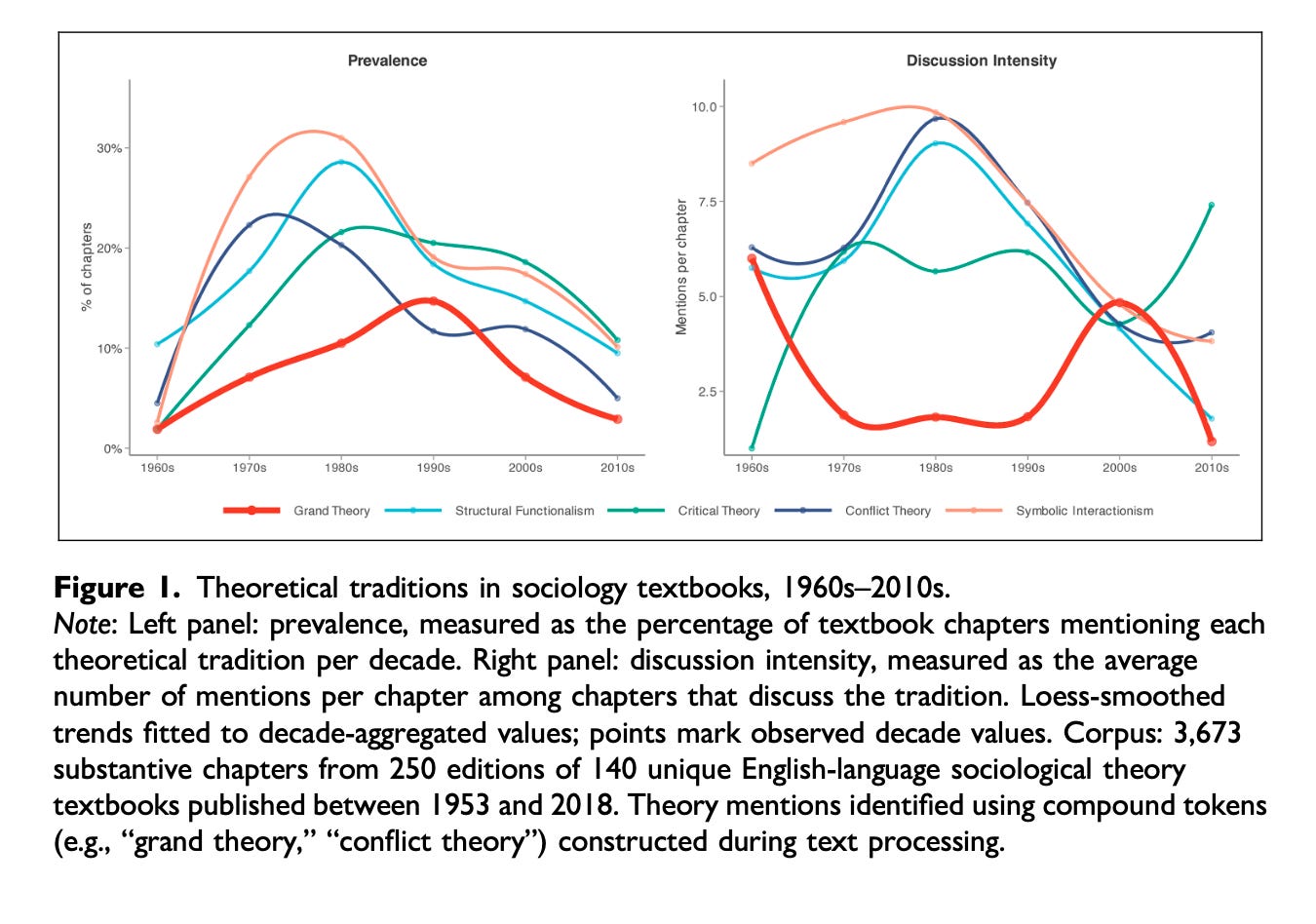
In our corpus, “grand theory” was first used by the textbook of Demerath and Peterson, who reproduced Mills’ critique and presented Talcott Parsons’ functionalism as the sole representative of “grand theory.” Other textbooks followed this restrictive application of the concept, but soon authors began to characterize additional theorists as “grand.” At the end of the 1970s, Margaret M. Poloma identified a “grand theoretical tradition” which, in addition to Parsons, included the protagonists of “classical sociology” he had founded his approach upon: Émile Durkheim, Max Weber, Auguste Comte, and Vilfredo Pareto. By the 1980s, “grand theory” included Neo-marxists (and Mills cried…), Peter Berger, Thomas Luckmann, Anthony Giddens, Habermas, Norbert Elias, and by the 2010s, Karin Martin wrote: “many feminists in the academy were writing ‘grand theory.’”
While this trajectory can look like a steady expansion in which the net of the original epithet is cast over a wider and wider set of targets, in fact the conception of the object changes along the way. To examine how the composition of grand theory has evolved since Mills’ original critique, we identified the theorists most strongly associated with grand theory discourse by adjusting for their baseline presence across all sociology textbooks.
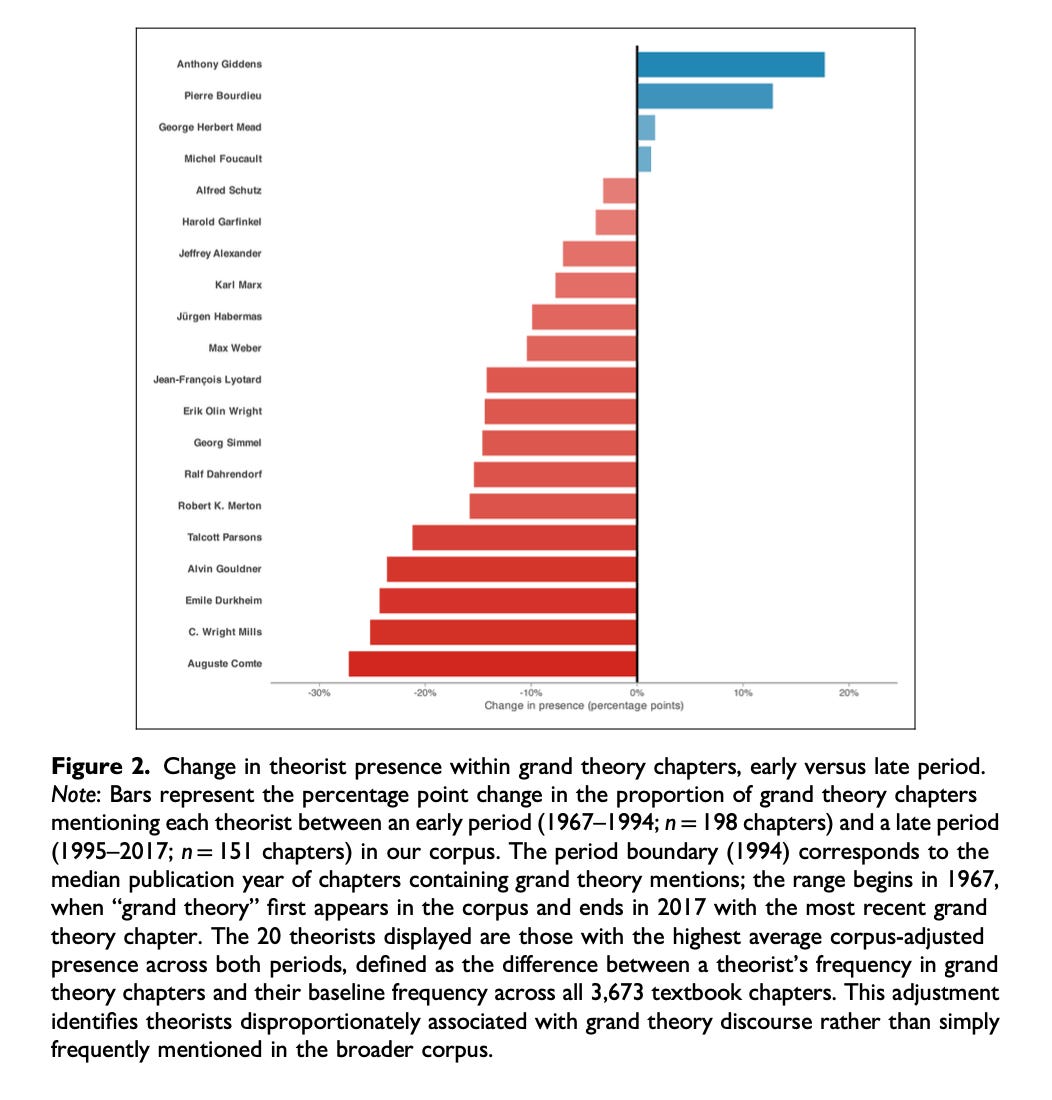
This figure highlights a geographic and intellectual reorientation in who counts as a grand theorist. The American mid-century figures who dominated the concept’s original context show a systematic retreat from grand theory discourse. Talcott Parsons declines by 21 percentage points between periods, while Mills himself drops by 25 points, suggesting that the original polemic has lost its centrality to how textbooks frame the concept.
This pattern extends throughout the structural-functionalist tradition: Robert K. Merton, Alvin Gouldner, and other American systematizers similarly fade from grand theory’s definitional core. In their place, European continental theorists have redefined “grand theory’s” conceptual core. Anthony Giddens shows the largest increase, appearing in nearly half of all grand theory discussions during the late period. Additionally, Pierre Bourdieu rises by 13 points, while Michel Foucault shows modest gains.
This shift represents more than a substitution of one set of names for another. While Mills attacked abstract system-building in American sociology, contemporary textbooks increasingly apply grand theory to European projects that combine theoretical ambition with empirical engagement in ways Mills’ original critique did not address.
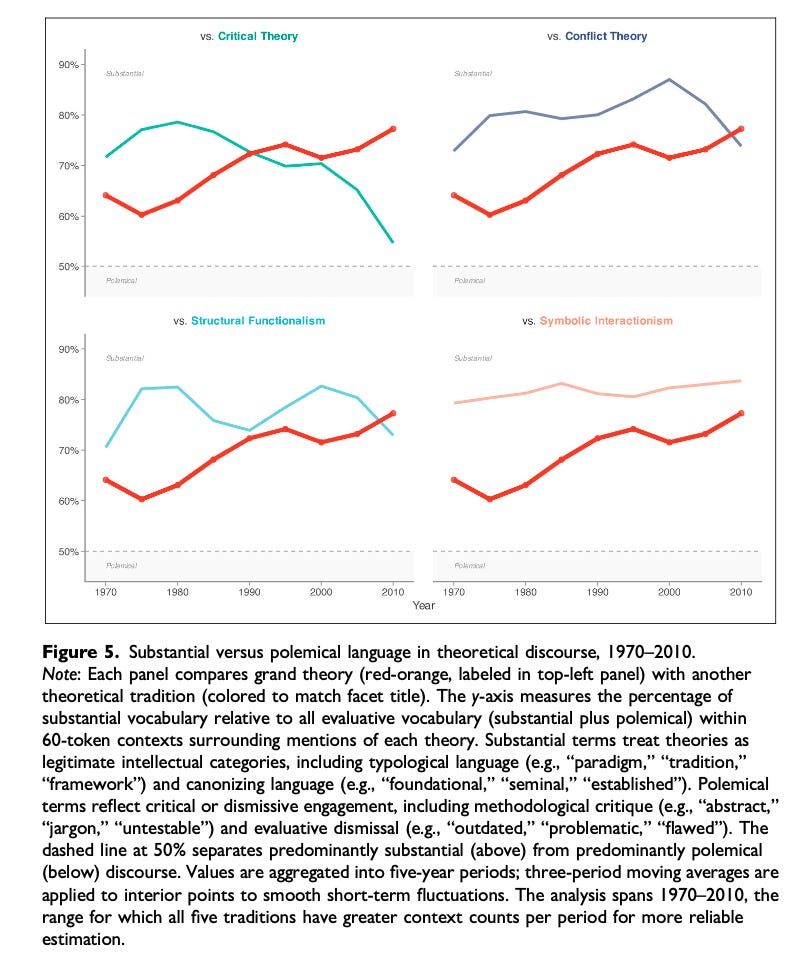
We document this shift with some additional analyses that specifically highlight changing linguistic associations of the term (for example, it becomes less associated with methodological and polemical terms), but the bottom line is that the concept has evolved from identifying specific targets (as in Mills’ critique) to picking out a type of theorizing characterized by scope and ambition rather than methodological failings.
These kinds of shifts tell us that something is changing, but it takes qualitative analysis to see more clearly into what is happening. For this, we identify four distinct strategies that textbook authors employ to discuss and evaluate sociological theories by classifying them as “grand.”
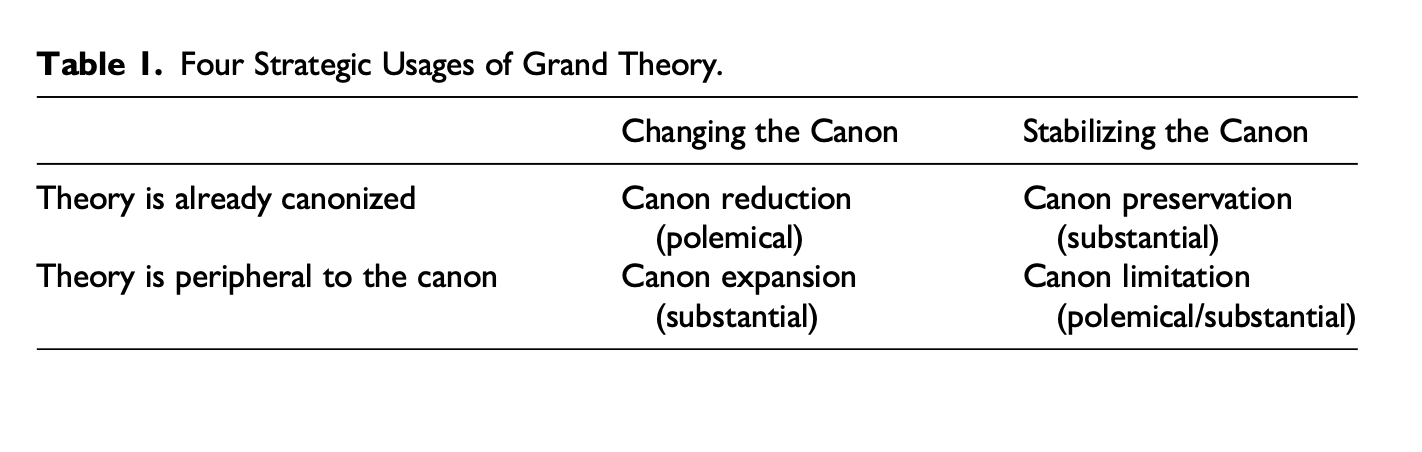
A theory can be presented as such in order to depict it as outdated and opaque, thereby relegating it to a peripheral position within the canon.
Textbook authors use “grand theory” to stabilize the established structures of the prevailing canon. In that sense, they regard a theory as deserving of commemoration and instruction due to its belonging to a distinctive intel- lectual tradition that is held in high worth.
A new or lesser known theorists may be designated as “grand” in order to legitimize their incorporation into the canon. By doing so, the concept serves as a means of canon expansion.
Theories that have not yet been incorporated into the sociological canon, or only marginally so, can also be characterized as “grand” to prevent them from entering the canon in the first place. Sociological theory is then often portrayed as the antithesis of philosophical or psychological grand theories, which do not belong to its canon.
We give lots of examples of these rhetorical strategies, but the overall impression one gets reading these varied uses is that as the concept receives more substantial treatment, the practices of its use grow increasingly arbitrary.
It is hard to avoid linking transformations in the concept of grand theory to the shifting fortunes of theoretical practice in the field. In sociology today, “theory” has become a subject taken once during one’s studies rather than than a field in which careers are advanced. This context makes the shifts in the scope and semantics of “grand theory” and its acceptance as a genuine variety of theory highly functional. It ensures the memory of certain theorists and thus the cohesion of the discipline, but by no means calls for more in-depth engagement: grand theory was something that happened back then, over there, but not now, by you.
“Once defined as a type, as a distinct form of theory, and placed alongside others in a relativizing manner, the promise of grand and thus ambitious theory fades. An expectation of truth and deeper insight then emanates neither from it nor from other types of theory.”
Thanks for this post! I love it! The intro especially fleshes out some of the background I only knew tangentially and gives more context than I knew. Super interesting. And the empirical results are great! The Fig. 1 is especially interesting: what do you make of the declining mentions overall in the first pane? The second pane, showing the rise of critical theory and conflict theory, fits my expectations, but combined with declining mentions is interesting and more complicated. Any sense of what's taking its place? Non-theory discussions?