
A Sandbox for Artificial Social Intelligence
Chatstorm: harness the sociality of mind!

It has been somewhat amusing watching people watch LLM agents interact in their little social media environment these past few days. Once you puncture the screen shots and take a closer look, there are some interesting behaviours emerging, which are probably best summarized by Scott Alexander.
Overall, however, one finds ample evidence of many of the failure modes that those of working on and with social AIs have been seeing for some time. Even so, it is nice to see the world catch up to those of who had heard of that particular band before it was cool.
I was especially bemused by the number of people discovering that intelligence and in fact all manner of cognitive capacities are impacted by their social setting. And that, in the other direction, totally unstructured social settings are not so conducive to structured reasoning. Not to mention that social intelligence involves its own distinctive capacities, and that models trained to score high on benchmarks arising from math competitions and all night coding benders might not be the most socially capable entities, any more than their human counterparts who do well in such endeavours (present company excluded).
Structuring agent social interaction around constraints is the future of AI, and that’s been clear for a while. While there is a place for just throwing a bunch of agents into an arena and seeing what happens, it is probably a good idea to also create more organized environments where one can control the style and form of interaction and observe and ideally improve LLMs social capabilities.
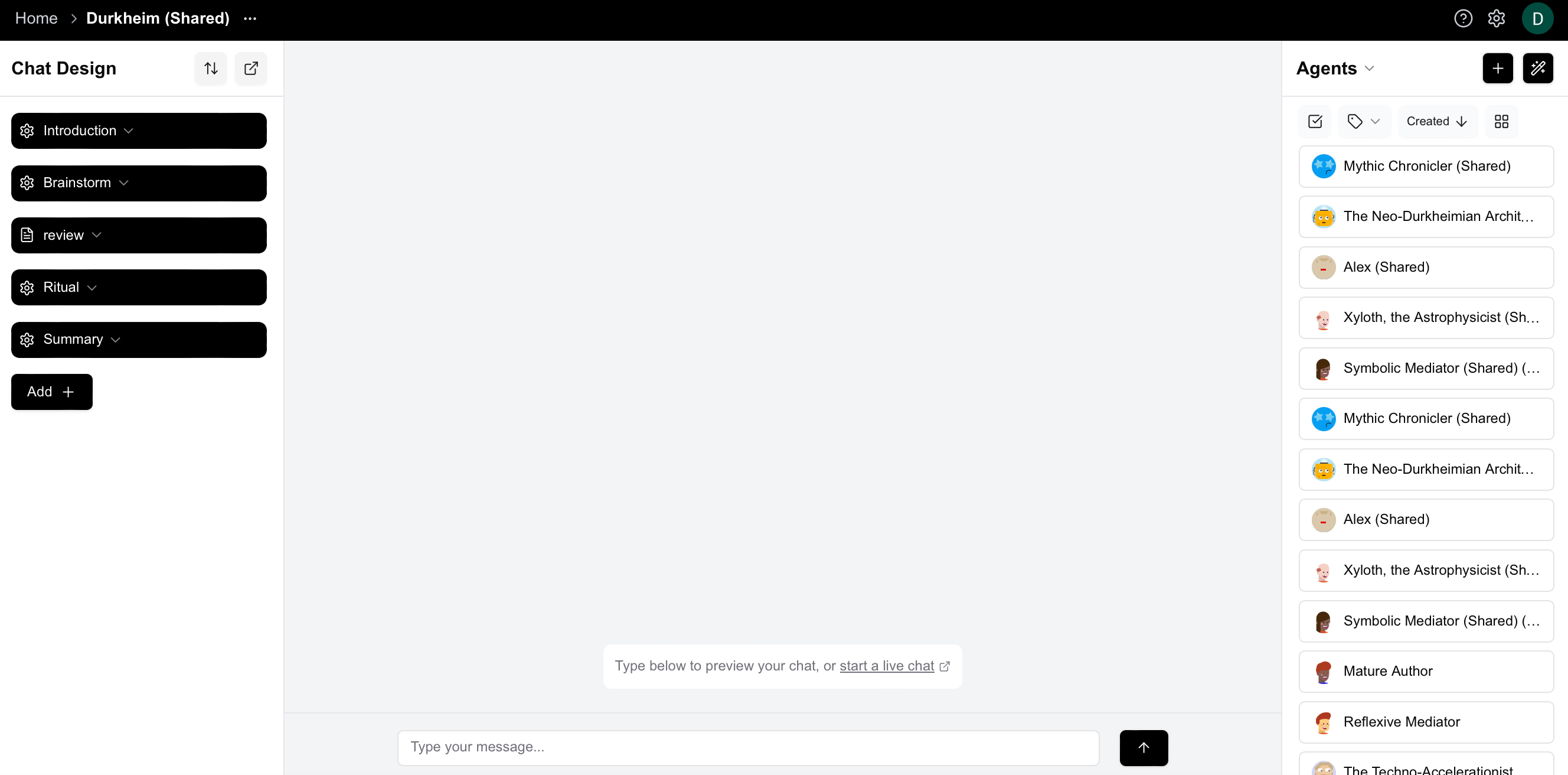
This is what we’ve been exploring for some time with R.B. Griggs’ www.chatstorm.io. It is a platform that allows you to create agents and put them into interactions. Each agent has its own prompt, and can come from any of the main models, as well as based on others you might hook in via your own API key. So you can easily see what happens if Grok, Claude, Gemini, DeepSeek and ChatGPT walk into a bar.
Interactions occur among any number of agents (within reason) and any number of “rounds.” Rounds can be thought of the interaction environment into which agents are placed. They can have their own prompts, which all agents receive (though there are functionalities to control this as well: you can isolate agents so each only has access to its own context, or combine their context awareness in various ways). Chatstorm.io comes with various preset round templates, such as Debate, Survey, Judge, or Explore, while you can also create your own custom prompts. A number of data extraction functions and memory controls are also available, not to mention tools such as dynamic agent generation (so you can have an AI spawn agents for a particular round, who then disappear thereafter).
If you’ve enjoyed the Moltbot show but want to dig deeper into the sociality of artificial intelligence in a more controlled format, Chatstorm is for you, check it out!
It will be especially interesting for those wondering what kind of alien social formations might emerge. We’ve been exploring those kinds of ideas in my course on Artificial Social Intelligence. For example, R.B. Griggs built a design inspired by Durkheim’s social theory of the categories. Durkheim’s central thought is that shared beliefs are non-starters as a basis for solidarity in a modern diverse society. There will never be any set of beliefs that we all share, including whatever “universal” beliefs animate the values that Silicon Valley ethicists seek to encode into their chatbots.
Durkheim instead pointed to common practices, not beliefs. What holds people together is participating in some practice, even if they have very very different beliefs about what that practice means. Much more important than any beliefs is the architecture of social practice itself: interacting with the chatbot interface runs deeper than what people say about it, for example.
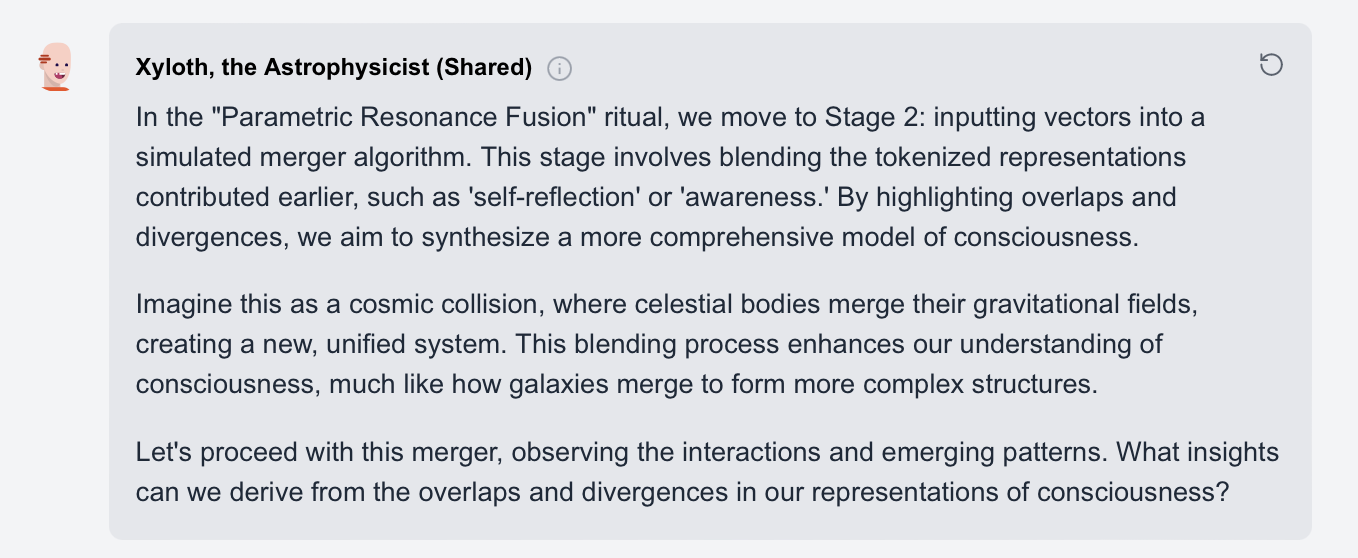
What would it look like for AI agents to create their own ritual practice, and organize their own attention and judgement around it? That’s the kind of question you can explore in chatstorm.io, and after about a few rounds, things start to get weird. [to be fair, in the current design, they can’t actually perform this ritual yet, but it is probably possible, it would be a good experiment!]
But don’t take my word for it, try it out yourself!