
That's problematic! When a case becomes a problem
On non-native and invasive species and the sociology of problematicness


You might remember various moments when discussions about the language of ecology and conservation biology have bubbled to the surface of public discourse. Is labeling a species “invasive” a form of xenophobia that perpetuates white supremacy and colonial thinking? Is it a purely biological term that merely designates a category of non-native species that is causing harm to existing ecosystems?
Wherever you find yourself on such questions, it remains the case that describing a species as “invasive” carries great weight. The more a species becomes considered invasive, the more likely it is to become the target of ecosystem management policies designed to control it within, or even eradicate it from, a given region. Such management policies are costly, not only in time and money, but also in that they often call upon local residents to change their practices (i.e. how they tend their gardens).
There are always more potential problems floating around than anybody tasked with dealing with them can handle, and many stakeholders who have some interest in one or the other candidate being considered as more or less problematic. When and why do some candidate species become more likely to be described as exhibiting various degrees of invasiveness? This is the question animating a new article published in Social Forces by myself, Tyler Bateman, Alica Eads, and Charlotte Kafka-Gibbons. This article really is Tyler’s baby, and he led the way from start to finish.
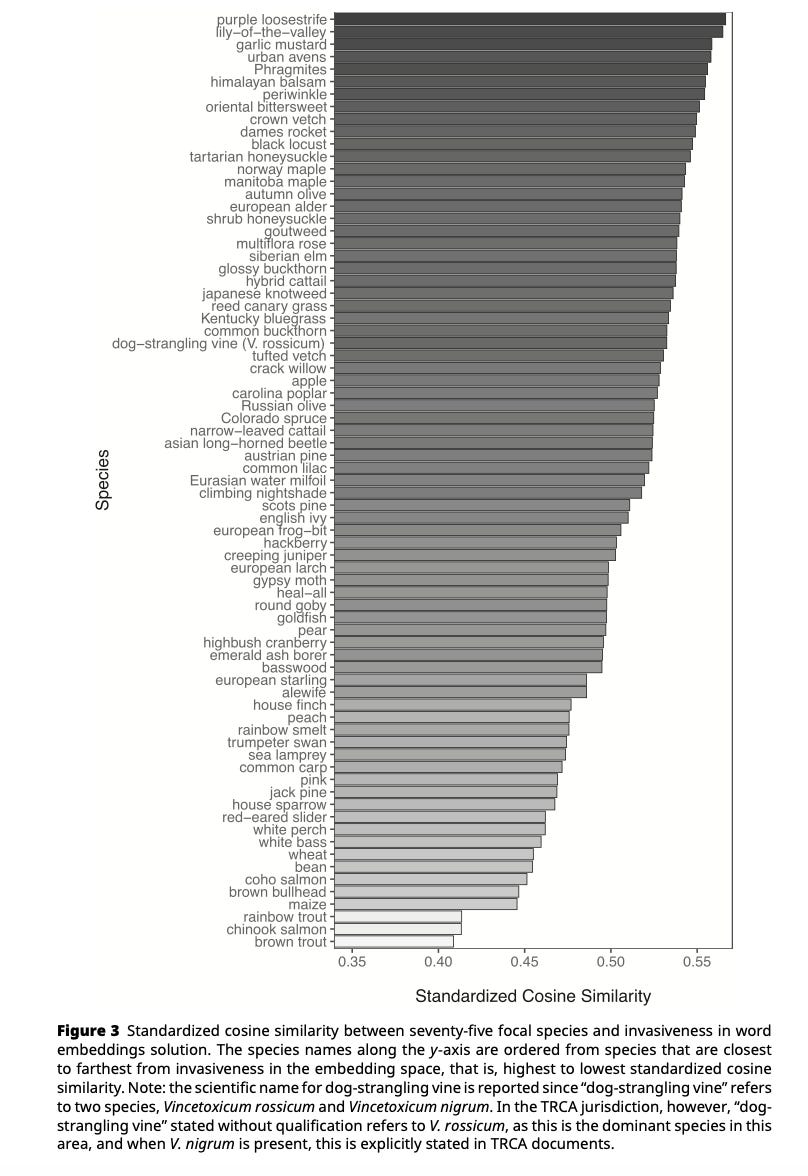
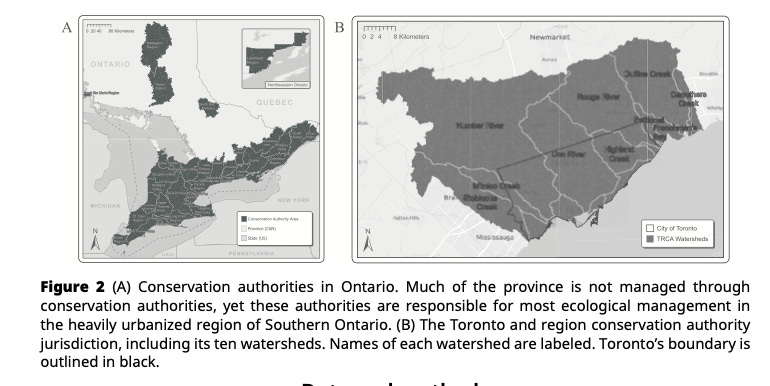
To tackle this question, we study documents from the Toronto and Region Conservation Authority (TRCA) and examine various propositions about which species would be more strongly discussed as invasive. You might think that invasiveness is more or less a function of what biologists say about a species. But anybody with experience in this field knows these considerations sometimes run up against those advanced by economic actors, often powerful ones, who sometimes want a given species to be controlled, and sometimes don’t, depending on how it would hit their bottom line.
We test both of those propositions, and find that the concerns of invasion biologists do play a strong role in shaping the discourse at the TRCA. By contrast, there is little sign that economic interests are strongly associated with a species being discussed as more invasive. That finding may be surprising, but keep in mind that the TRCA is primarily managing an urban region, and things might look different in rural authorities where agriculture and forestry industries are big players.
In any case, our central contribution is that a third process seems to play a strong role, which we call “workability.” This just means that a species is more likely to be treated as a problem when it is easier to deal with by the managing authority — even when it is equally harmful or dangerous as another problem candidate. For example, it is often a lot easier to deal with shrubs and wildflowers than birds, just because the birds can move fast and fly. Many fish are hard to monitor and control; they live underwater after all, and we do not. Other species are already hyper-abundant, and so strong intervention is basically pointless; there is nothing to be done but manage or accept them. We find solid support for this hypothesis.
As is the custom in sociology, we discuss these dynamics around invasiveness as an illustration of what is likely a broader phenomenon and a suggestion to examine this notion of “workability” more generally. You’ve probably observed something similar in your own organization, where, from the usually large universe of problems that could be taken on, only some are, and not only because those are the most problematic, but also because they are something the organization could actually imagine itself dealing with, or not, as the case may be. I’d wager a surprisingly large number of cases that pass through various social filters on the way to becoming thought of as problems do so based on some such notion of what is practically workable or not.
It is important to resist the temptation to dismiss this kind of finding and insight as trivial. It is actually a nice example of a form of sociological pragmatism, which often involves various kinds of reversals. Thought, the pragmatists argued, is often a function of practice. For example, you might think that organizations start from some mission that defines their vision, and their work is a kind of expression of that prior idea. In fact, more often than not, one of the most important goals of an organization is to figure out what its goal is, and that is something that only often becomes clear in retrospect or on the fly. Likewise, one of the most important problems an organization faces is to figure out what kinds of problems it can handle. These are not set out in advance, but arise through an ongoing process of action and learning.
Here is the abstract: Research on social problems often analyzes how different groups think or act in relation to a single issue. Less frequent are studies of how a single group thinks or acts in relation to many phenomena, any of which may be construed as problematic to a greater or lesser degree. We take this multiple phenomena-single social position approach and analyze why the Toronto and Region Conservation Authority (TRCA), a supra-municipal government agency, discusses some non-native species as more "invasive" than others. We use word embeddings to measure variation in the strength of association between different species and invasiveness in 599 of the TRCA's policy documents and employ generalized additive models to explain this variation. We find that the "invasive" meaning is more strongly associated with species that are easier to observe, access, control, or manage in the TRCA's urban context, which we term workability. Species that are terrestrial, sessile, and moderately abundant are more strongly associated with invasiveness than mobile, aquatic, and hyperabundant species. These findings suggest that problem managers conceive of issues they are responsible for managing according to how actionable problems appear. We propose workability as a key analytic lens for understanding how problem managers make decisions and construct meaning. We situate this contribution in the context of four research designs for studying social problems that we term comparative problem-solving designs.
There is nothing wrong with this post
So is this like the sociological version of looking for your keys under the streetlight, because that's where it's easiest to see them?