

One of the fundamental challenges of liberalism is that it operates at one step removed from our primary commitments. Some may prize justice, others God, others family and community, others nation, others wealth, others pleasure, others power. For anybody strongly committed to any of these or more, the best society can seem to be the one that realizes that value the most fully, at the expense of the others.
Liberalism, by contrast, requires that you be able to somehow, at least temporarily and periodically, and in specific domains, suspend your primary commitments and consider that in a large and complex society there will be multiple such commitments, often irreconcilable. The challenge is at minimum how they can coexist. Even better would be for them to somehow mutually benefit one another. In any case, the liberal asks you to step back from what you consider good and to prize the conditions under which cooperation and order can persist.
This second-order standpoint can seem pale in comparison to the first-order convictions. First-order commitments inspire faith and love, passion, appetite, movement, great and base deeds. The second is reflective, grounded on a warning or recollection of the dangers of singular commitment to any particular vision of the good.
I was thinking about this after reading an old review that Allan Bloom wrote of John Rawls’ A Theory of Justice. The review is a terrific piece of writing, full of great quips, and more importantly, some penetrating insights. The most striking is the difference between the Rawlsian “original position” and the “state of nature” in classical social contract theories, especially the Hobbesian.
Bloom saw that while Rawls is notionally part of that social contract tradition, there is a massive difference in the way they imagine the situation from which their respective social contracts emerge. Rawls’ original position is abstract. You place yourself in an imaginary setting where you do not know what type of person you will become.
Once men are aware of the original position they will abandon their overreaching: they will recognize that there are no legitimate claims to special privilege and will be dissuaded from using the power deriving from any unequal possession of primary goods to command such privileges.
The Hobbesian state of nature is a very different beast. It is full of beasts. It does not ask us to strip away all primary commitments but rather forces us to ask ourselves what life would be like without the protections that society affords us. The answer, the only and singular answer, is that it would be terrifying.
That fear is not an abstraction, a hypothesis, an imagination, but an experience, a powerful passion which accompanies men throughout their lives. This passion is sufficient to provide a selfish reason, a reason that men can be counted on having, for adherence to a civil society which is dedicated to preserving them.
The liberal order holds a lid over a bubbling froth of fear, fraud, force, and all manner of nastiness, just waiting to boil over if we let our guards down. The function of “the state of nature” is to remind us of this perpetually present possibility of social breakdown, and where we’ll end up if we take off the guardrails. It creates a sense of equality and shared commitment not by asking us to treat each other fairly in the abstract, but by reminding us, by invoking a kind of existential dread, that we are all equally afraid in the state of nature and all in need of some agreement that will allow us to reduce that fear.
Bloom makes a powerful argument. There are various responses a Rawlsian might offer at an intellectual and philosophical level. But none of them get to Bloom’s central point, which is that Rawlsian-style liberalism — our liberalism — can lack an existential core. Even worse, according to Bloom, is that it only speaks to those who lack such a core, and remains mute when faced with those with great appetite and great ambition, who simply would not accept the original position, or would violate its precepts the moment the contract was signed.
Yes, there are various intellectual answers to this question. But the deeper problem is one of poetry not philosophy. Liberalism seems unpoetic and unloveable. Abstract defences only reenforce this. Communism or nationalism inspire poetry. Liberalism inspires analytical philosophy, which inspires nobody.
A striking fact about Rawls (not to mention Habermas, against whom similar complaints can be lodged) is that his youth was marked by direct experience of war. He was an infantryman in New Guinea and the Philippines. During his undergraduate studies, he considered joining the priesthood and wrote a senior thesis on “The Meaning of Sin and Faith.” Habermas was a member of the Hitler Youth and was sent to the Western Front during the last days of the War.
These giants of contemporary liberalism knew about fear and faith, and set out to create a justification for a social order in which those forces would be denuded. You can’t quite understand Habermas’ ideal speech condition unless you can see the spectre of Nazi rallies looming, just as you can’t understand Rawls’ original position unless you see the mushroom clouds sprouting up behind it.
So I wondered what it’d be like to try to tell a little parable about a fictional John Rawls, where even little decisions about allocating resources in the liberal order take place against the background of a kind of existential dread. The below is the result.
Alas, I discovered once again that I am not a very good writer. But here it is anyway, just try to imagine what it’d be like if Knausgaard had written it!
John turned into the supermarket parking lot a little too fast and had to brake to avoid a stray cart that had drifted out of its corral. His wife and kids had sent him there on an early Sunday morning, to get some breakfast cereal. They had all been arguing. His oldest daughter wanted Frosted Flakes, his youngest, Honey Nut Cheerios, the middle one wanted regular Cheerios. His wife wanted Muesli.
He himself didn’t care; he was indifferent. A child ran past him. He barely noticed.
The biggest drama in his life was about breakfast cereal. He was comfortable, but also a bit dull. “Dull is at least better than war.”
He had not noticed himself walking into the store, but there he was, in the cereal aisle, standing before a wall of choice.
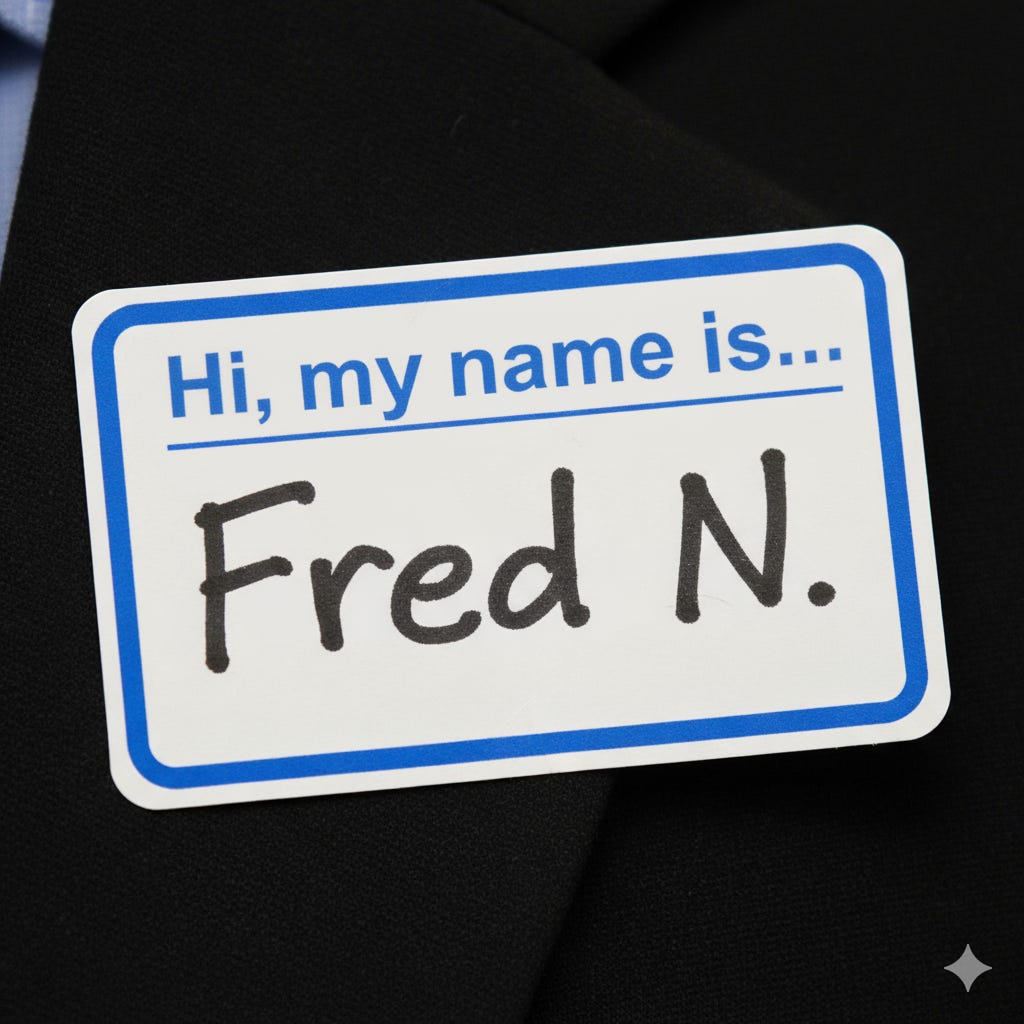
A man was suddenly near him. John had not heard him come. The man was slight, older than John but not by much. He had a narrow face and a heavy mustache. He was wearing a name tag, which read “Hi, my name is Fred N.” He wore a dark coat and carried a handbasket.
He looked at John, and smiled.
“What if a demon were to creep after you into your loneliest moment and say to you: this life as you now live it and have lived it, you will have to live once more and innumerable times more. There will be nothing new in it, it will all happen again, in the same succession and sequence.”
John stared at him. The man went on.
“Would you throw yourself down and gnash your teeth and curse the demon who spoke thus, or would you answer him: you are a god, and never have I heard anything more divine.”
People were passing them. A woman with a list folded in her hand. A teenage boy in a school jacket.
The man’s eyes were brighter now.
“Would you accept all of your choices, not once, not twice, but eternally and infinitely? Would you, John?”
John cleared his throat.
“Sure, no problem. Yeah no, I’m good. I am here to buy cereal, eh.”
The man took a box of Wheaties from the shelf, put it into his basket, and walked away.
John thought that this encounter was kind of weird, but neither did it shake him very much. He was happy with who he was. Things had been harder in the past, his life was comfortable now, and so was that of everybody around him.
“Yes, this is the best possible life, in the best of all possible worlds, and I’d live it again, and again, and again,” he told himself. “Yes I would, no yeah, indeed I would.”
His eyes returned to the cereal. He remembered staring into the abyss of milk in his bowl of tasteless oatmeal as a child. It was grey and lukewarm, but he had found a way to make a playful sport out of it.
He’d try to time his pace of eating with its cooling, to find the optimal time before it became inedible. The perfect bite was the one that he’d take exactly then, not too hot, not too cold.
He’d look at the cooling gruel, and when it was hot, he’d imagine somebody with hot passions ready to dive in. Literally dive in: like jump into the oatmeal, swim around in it, cover your skin with it, burn your skin with it, just to show that you were willing to do something like that.
Then his thoughts would turn around, and he’d imagine being a totally different person. This one gloried in suffering. He wanted the oatmeal to be so disgusting that you could barely put it in your mouth without retching. He stared at the cooling bubbles.
“There’s no way I could ever put that in my mouth.” But he had too, so he did.
As a child, he played like this for hours, testing his ability to imagine every possible life reflected back to him in his breakfast cereal. He would win if he could find the perfect bite, the one which every single possible life he could imagine would eat. He rarely won.
“Hey buddy, what are you looking at.”
Another guy had come up to him. He was more ordinary looking. He was wearing a fleece, dark blue, with a small mountain logo on the chest. He wore jeans, good jeans, and his hair was short, but not too short. He looked like he jogged.
The man looked John in the eye, and somehow it was terrifying, far more so than the last one.
“Imagine: you must accept a condition if you want to live with other people. Each time you arrive at a conflict, any dispute, however small, you must, in that moment, drop everything you are: your name, your history, the trenches, your faith, your comfortable suburban life. You must stand again as if behind a veil without skin, sex, cleverness, greatness, cowardice, cunning.”
“You must choose so that, if you were to wake up as any of those possible persons who would live with that choice, again and again, you could still say: yes.”
“Uhhhhhhh, whaaaaat???” John said.
“You will not do this once,” the demon said. “You will do it every time. You are never excused. You must always choose as if you could be the one most hurt by your choice.”
The demon waited. His basket was still empty.
“So I would have to be able to renounce even this comfortable life I have been leading for the past decades.”
“Correct,” he said.
“I liked the other guy better, where’d he go”?
The demon grinned.
“His time has passed. He was meant for hard times and hard men.”
“It would make some lives smaller,” John thought.
“It would make many lives less tragic,” the demon responded
“You will fail often,” he said.
“Yeah, I know,” John said.
“When you find it too hard, put yourself again in this original position, here in front of the cereal shelf. Return to this position eternally, now and forever, and treat every great decision as fatefully as this little one.”
John was alone, and he was scared.
The thought, “Parties in the original position are mutually disinterested” came to him in a flash.
He again stared at the boxes. He went one aisle over and bought some oatmeal, some blueberries, some almond slivers, and some powdered sugar.
He drove home, afraid that somebody in his family would find his solution unfair. An image of the demon flashed before him. He drove faster, in fear and trembling.